




Call Us

02 42068378
Office Hours: 9am-5pm

logo 1
The “Experience Catch-22” is Killing Your Earnings | How to Break Into the 2026 Illawarra Boom

The “Experience Catch-22” is Killing Your Earnings | How to Break Into the 2026 Illawarra Boom

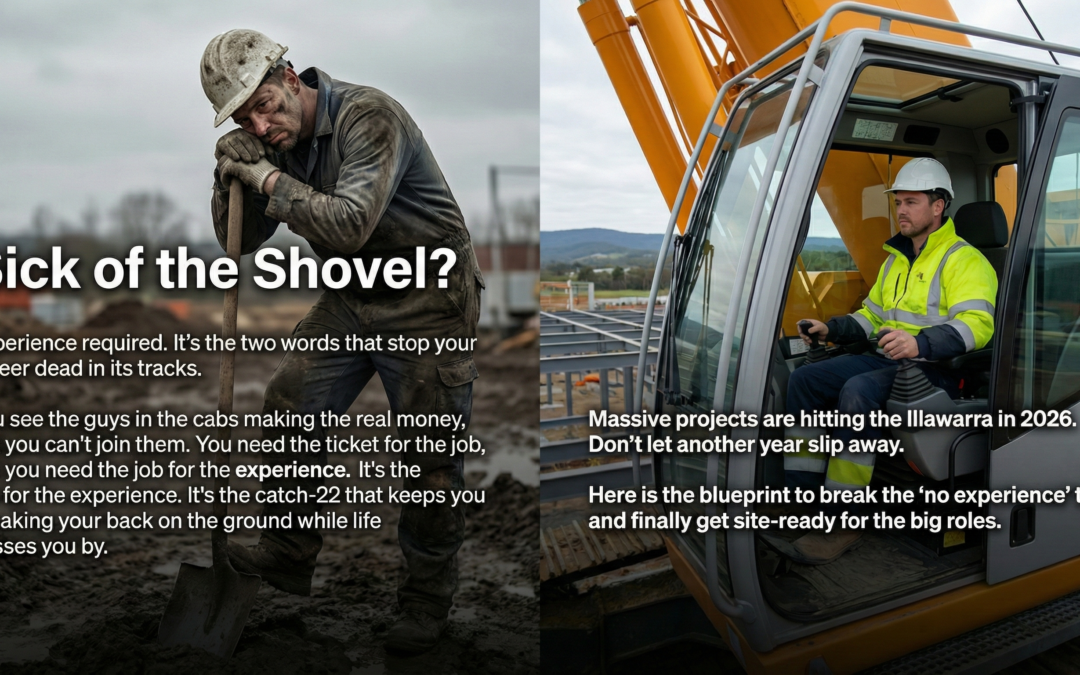
It’s the phone call every labourer in the Illawarra hates making.

You see the ad on Seek or hear about a start from a mate. The money is good—$50 an hour, plus travel, plus penalties. The site is local. You’ve got the White Card, the PPE, and the work ethic. You’re ready to go.

So you ring the foreman or the recruiter. The chat goes well until they ask the killer question:

“How many hours have you got on the crane?” or “How long have you been dogging?”

You’re honest. You say, “I’m looking for a start so I can get the experience.”

The tone changes instantly. “Sorry mate, we need someone who can hit the ground running. Insurance won’t let us take on green guys. Call us when you’ve got two years under your belt.”

Click.

This is the Experience Catch-22: You can’t get the job without the ticket and the experience, but no one will give you a start so you can get the experience.

So, you go back to the shovel. You go back to “dead-end labouring,” breaking your back for $32/hr while watching the ticketed operators sit in air-conditioned cabs earning double your wage.

But here is the reality check: 2026 is going to change the rules of the game in the Illawarra, and you cannot afford to be stuck on the wrong side of the fence.

Market Intel – Why 2026 is Different

We are staring down the barrel of one of the biggest infrastructure shifts the Illawarra has seen in decades. This isn’t just standard residential construction; this is heavy industrial transformation.

If you drive past Port Kembla today, you are looking at the future ground zero of NSW industry.

  1. The BlueScope Land Transformation – With over 200 hectares of surplus land being rezoned and redeveloped, we are talking about massive civil works, warehousing, and logistics hubs.
  2. The No. 6 Blast Furnace Reline – These massive maintenance projects require an army of Riggers, Doggers, and Scaffolders working around the clock.
  3. The Illawarra Renewable Energy Zone (REZ) – As the wind farm logistics ramp up, the demand for heavy lifting and load shifting will skyrocket.

The “Ghost Job” Reality

Right now, you see ads saying “Willing to Train.” Most of these are what we call “Ghost Jobs.” HR departments post them to gather resumes just in case, but when the pressure is on, they never hire the trainee. They hire the guy who is ready now.

When these 2026 projects kick off, they won’t have time to hold your hand. They need operators who are “Plug and Play.”

The Trap – The “Tick and Flick” Disaster

When you realise you need a ticket to get ahead, you might be tempted to find the cheapest, fastest course possible. You know the ones—the “Tick and Flick” joints that promise to get you the piece of paper in a day or two.

This is a career-killing mistake.

Here is the secret recruiters won’t tell you: The ticket gets you the interview, but the VOC gets you the job.

A VOC (Verification of Competency) is a practical test you do on your first morning on site. The safety officer will put you in the seat or hand you the whistle and say, “Show me you can do this safely.”

If you went to a “Tick and Flick” school:

  • You won’t know how to confidently calculate the Working Load Limit (WLL).

  • You’ll fumble with the sling selection.

  • You’ll look nervous.

Result: You are walked off site before lunch. Your name gets marked as “unsafe” in their system. That cheap course just cost you a $100k job.

The AOTA Difference – We Simulate the Job Site

This is where AOTA (All Onsite Training and Assessment) changes the math. We don’t just teach you to pass a SafeWork test; we are building the bridge between “Green” and “Site Ready.”

Located right here in the Illawarra (Unanderra), our facility is designed to break the Experience Catch-22.

1. It’s Not a Classroom, It’s a Simulation

We don’t teach from a textbook in an air-conditioned room all day. We are in the yard. We are using real cranes, real loads, and real steel. When you train with us, you are logging hours that simulate the actual pressure of a site.

2. Trainers Who Have “Done the Time”

Our instructors aren’t academics. They are veterans who have run crews on the biggest sites in Australia. They teach you the “unwritten rules”—how to talk to a crane driver over the radio, how to spot a hazard before it happens, and how to work efficiently without cutting corners.

3. The “AOTA Stamp” Means Something

Local employers know AOTA. When they see our name on your training history, they know you haven’t just bought a ticket—you’ve earned it. That reputation helps you bypass the “no experience” filter.

How to Beat the Catch-22 (Your Strategy)

Once you get your ticket with AOTA, don’t just email your resume. Here is how you get the start:

  1. Show Up – Go to the site office or the labour hire depot in person.
  2. Own Your Training – Say this: “I’ve just got my Dogging ticket through AOTA. I haven’t got 2 years on site, but I’ve been trained properly on real loads, I know my load charts, and I’m ready to pass a VOC today.”
  3. Offer the “Free Trial” – Tell them, “Put me on for a day. If I’m not safe and useful, don’t pay me.” (They will rarely take you up on not paying, but the confidence usually gets you the job).

2026 is Coming. Don’t Be Left Holding the Shovel.

The “Experience Catch-22” is real, but it can be beaten. The only way to break the cycle is to force the door open with a High Risk Work licence that proves you are an asset, not a liability.

Don’t wait until the projects start and the courses are booked out. Invest in yourself now.

Ready to upgrade your paycheque?

Check out our 2026 courses  or drop into our facility in Unanderra to see how we train the best.

Ready to unlock your full potential? Explore our website further to discover the perfect training path for you. Or, if you have any questions or need personalised guidance, don’t hesitate to contact us. Our friendly team is here to support you every step of the way.

Remember, your dream career is within reach. With AOTA by your side, you can build the skills, confidence, and qualifications you need to succeed. So, take the first step today and start building your future!

Dedicated to your success

Nigel

Know the Risk | Interactive Hazard Finder

From high-risk zones to hidden hazards, this interactive tool helps you identify worksite dangers and shows you the safety training to tackle them confidently.
Advanced Rigging Course Illawarra, Become an In-Demand Expert in 2026

Advanced Rigging Course Illawarra, Become an In-Demand Expert in 2026

Advanced Rigging Course – Elevate Your Skills and Career in the Illawarra’s Thriving Industries

The Suspense of the Steel, Witnessing Advanced Rigging Mastery

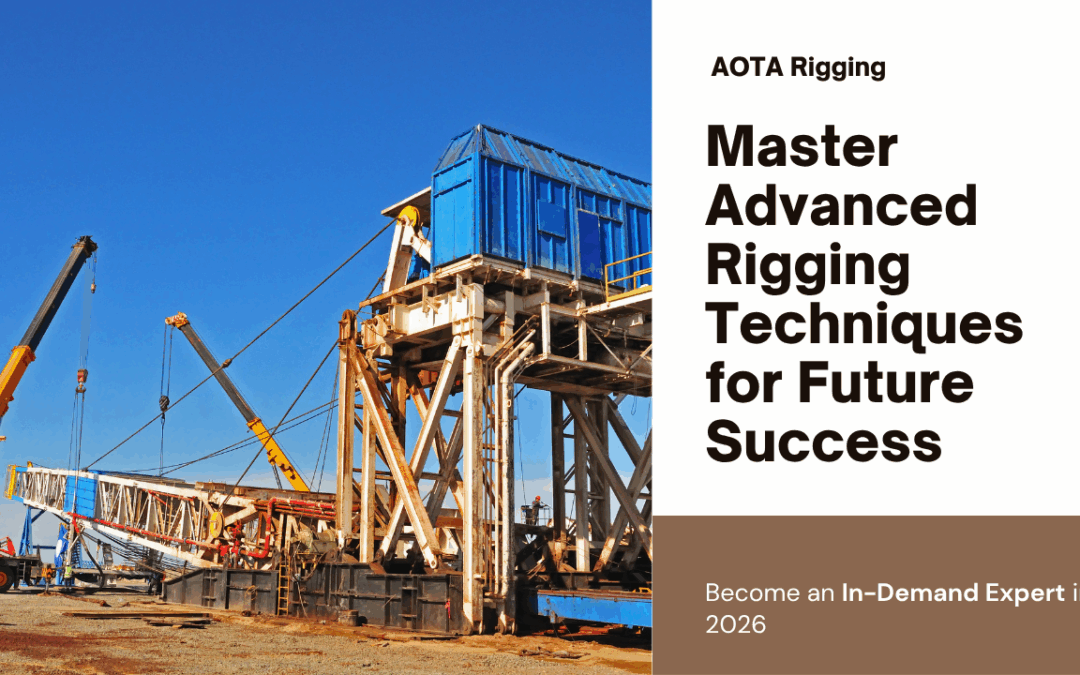
Picture this, a massive steel beam, longer than a bus, suspended high above the ground. Below, a team of riggers works with orchestrated precision, guiding the beam into place with a complex network of ropes, pulleys, and winches. It’s a high-stakes ballet of engineering and skill, and at the heart of it all is the advanced rigger, the maestro of this intricate operation. It takes years of experience to master this type of work, as well as a great deal of skill.

That’s the power and precision of advanced rigging – a specialized field that goes far beyond the basics. In the Illawarra, with its booming construction, mining, and heavy industries, the demand for advanced riggers is skyrocketing. These are the professionals who handle the most complex and challenging lifting operations, ensuring safety and efficiency in high-pressure environments. According to the Australian Government Job Outlook, the demand for riggers is projected to grow by 9.2% in the next five years. This presents a unique opportunity for those who have mastered the skills of advanced rigging.

Beyond the Basics – What You’ll Learn in an Advanced Rigging Course

You’ve mastered the fundamentals of rigging. You can tie your knots, sling your loads, and work safely with cranes. But the Advanced Rigging Course (CPCCLRG4001A – Licence to perform rigging advanced level) takes you to a whole new level of expertise. This is where you become a true master of your craft, capable of handling the most demanding rigging challenges.

Advanced Lifting Techniques – Mastering the Art of Complexity

The Advanced Rigging Course delves deep into specialized lifting techniques that go far beyond routine operations. You’ll learn to:

  • Orchestrate multi-crane lifts; Coordinate the movements of multiple cranes to lift and position incredibly heavy or awkwardly shaped loads. This requires precise communication, meticulous planning, and a deep understanding of load distribution and crane dynamics. This is a very complex task, and should only be attempted by those with extensive experience.
  • Tilt and turn loads with finesse; Utilize specialized equipment like tilt tables, turntables, and hydraulic jacks to manipulate loads in multiple planes. Imagine rotating a massive piece of machinery to fit through a narrow opening or tilting a pre-fabricated structure into its final position. Many large factories, such as Bluescope Steel, will have dedicated teams for this type of work.
  • Install guyed derricks and structures; Learn how to assemble and operate guyed derricks, temporary lifting structures used for heavy lifting in locations where conventional cranes are impractical. This is a skill that is highly sought after in the construction and mining industries, and is a very specialised field.
  • Erect flying foxes and cableways; Master the techniques for setting up temporary cableway systems used to transport materials and personnel across challenging terrain, such as valleys or construction sites. This is also a very specialised skill, and takes many years to master.
  • Construct hung and cantilevered crane loading platforms; Learn to build specialized platforms that extend from buildings or structures, providing a safe and efficient way to load and unload materials using cranes.

Advanced Load Calculation and Planning – The Science Behind the Lift

Advanced rigging isn’t just about brute force; it’s about meticulous planning and precise calculations. You’ll learn to:

  • Determine safe working loads in complex scenarios: Go beyond basic load charts and learn to calculate the forces acting on rigging gear in multi-point lifts, angled lifts, and other non-standard situations. This requires a strong understanding of physics, trigonometry, and engineering principles. This is a crucial step in the planning process, and is essential to ensure that the lift can be completed safely.
  • Develop comprehensive lift plans; Create detailed plans that account for every aspect of a complex lift, from load characteristics and rigging gear selection to potential hazards and contingency measures. The ability to create lift plans is one of the most important skills an advanced rigger can have.
  • Understand and apply advanced rigging principles; Delve deeper into the science of rigging, exploring concepts like load moment, center of gravity, and the effects of friction and wind loading.

Advanced Safety Practices – Minimizing Risk in High-Stakes Environments

Safety is paramount in any rigging operation, but in advanced rigging, the stakes are even higher. The course reinforces the importance of:

  • Rigorous risk assessment; Learn to identify and evaluate potential hazards associated with complex lifts, and develop strategies to mitigate those risks.
  • Comprehensive hazard control; Implement a hierarchy of controls to eliminate or minimize hazards, from engineering controls to administrative controls and personal protective equipment (PPE).
  • Emergency procedures; Develop and practice procedures for responding to unexpected events or emergencies during lifting operations.

Equipment Expertise – Mastering the Tools of the Trade

The Advanced Rigging Course introduces you to a range of specialized equipment used in complex lifting operations, including:

  • Gin poles and shear legs; Learn how to use these traditional lifting devices for heavy lifting in situations where cranes are not feasible.
  • Specialized winches; Gain proficiency in operating various types of winches, including multi-drum winches and capstan winches. These are often used for lifting and moving heavy loads, and can also be used to tension cables.
  • Load cells and monitoring devices; Understand how to use load cells and other monitoring devices to accurately measure and manage the forces acting on rigging gear during complex lifts.

Why Advanced Rigging Skills Are in High Demand in the Illawarra

The Illawarra’s industrial landscape is a hotbed of activity, and that means a constant need for highly skilled advanced riggers. Here’s why:

Complex Construction Projects: Building Bigger and Bolder

From towering apartment buildings in Wollongong to major infrastructure projects like the Albion Park Rail bypass, the Illawarra is seeing a surge in complex construction. These projects often involve:

  • Heavy pre-fabricated components: Lifting and placing massive concrete panels, steel beams, and other pre-fabricated elements requires the expertise of advanced riggers.
  • Challenging site conditions: Tight spaces, uneven terrain, and working at heights all demand advanced rigging skills to ensure safety and efficiency.
  • Specialized lifting operations: Erecting bridges, installing large-scale public art, and constructing unique architectural features often require non-standard rigging techniques.

Specialized Mining Operations – Keeping the Mines Running Smoothly

The South32 mines near Appin and Dendrobium rely on advanced riggers for a variety of critical tasks, including:

  • Equipment installation and maintenance: Installing and maintaining heavy machinery, such as longwall shearers and continuous miners, often involves complex rigging operations in confined spaces.
  • Shaft and tunnel maintenance; Advanced riggers play a vital role in maintaining and repairing mine shafts and tunnels, often working in challenging and potentially hazardous environments.
  • Emergency response; In the event of an equipment failure or other emergency, advanced riggers may be called upon to perform complex rescue or recovery operations.

Heavy Industry Demands – Maintaining the Region’s Industrial Backbone

Facilities like BlueScope Steel in Port Kembla require advanced riggers for:

  • Plant maintenance and shutdowns; Regular maintenance and periodic shutdowns of industrial plants often involve complex lifting operations to remove, repair, and reinstall heavy machinery.
  • Equipment upgrades and modifications; As technology evolves, advanced riggers are needed to install new equipment and modify existing systems, often working within tight deadlines.
  • Specialized lifting tasks; Moving and positioning large and awkwardly shaped components within the plant requires the expertise of advanced riggers.

Port Operations: Handling the Heaviest Loads

Port Kembla‘s bustling operations rely on advanced riggers to;

  • Load and unload unconventional cargo; Beyond standard containers, the port handles oversized and heavy cargo, such as wind turbine blades, mining equipment, and large industrial components. These require specialist advanced rigging techniques.
  • Maintain and repair port infrastructure; Advanced riggers are involved in maintaining and repairing cranes, gantries, and other vital port infrastructure.
  • Respond to emergencies; In the event of a cargo spill or other incident, advanced riggers may be needed to assist with cleanup and recovery operations.

The Benefits of Completing an Advanced Rigging Course – Elevate Your Career

Investing in an Advanced Rigging Course is an investment in your future. Here’s how it can benefit you;

Become a Highly Sought-After Specialist

Advanced riggers are a rare breed, possessing a unique skillset that’s in high demand. Completing this course sets you apart from the crowd and makes you a highly valuable asset to employers in the Illawarra and beyond. The skills you learn will be transferrable to almost any industry, meaning you will have many different career options available.

Command Higher Wages

Your specialized skills and expertise as an advanced rigger will translate into significantly higher earning potential. Employers are willing to pay a premium for individuals who can safely and efficiently handle complex lifting.

Take Your Rigging Career to the Next Level – Enrol Today

The Illawarra needs skilled advanced riggers, and the Advanced Rigging Course is your pathway to becoming one of them.

Choosing the Right Training Provider: Experience Matters

When selecting an RTO for your Advanced Rigging Course, look for a provider that:

  • Employs highly experienced trainers; Your trainers should have extensive real-world experience in advanced rigging, not just theoretical knowledge. They should be able to share practical insights and anecdotes that bring the training to life.
  • Offers hands-on training with industry-standard equipment; You need to train on the same type of equipment you’ll be using in the field. This ensures that your skills are directly transferable to the workplace.
  • Has a proven track record of success; Look for an RTO with high completion rates and positive feedback from graduates.
  • Provides ongoing support; The best RTOs offer support to their students even after they complete the course, helping them with job placement and career advice.

Prerequisites – Are You Ready for the Challenge?

Before you can enrol in the Advanced Rigging Course, you’ll typically need:

  • A current Intermediate Rigging (RI) HRWL; This demonstrates that you have a solid foundation in rigging principles and practices. RI Course Link
  • Relevant industry experience; RTOs may require a certain amount of documented experience working as an intermediate rigger. This ensures that you have the practical experience needed to succeed in the advanced course.
  • A strong commitment to safety; Advanced rigging demands a meticulous approach to safety. You need to be dedicated to following procedures and minimizing risks.

Course Duration and Assessment:

The Advanced Rigging Course typically takes 5 days to complete, although this can vary depending on the RTO and the specific course structure. Assessment usually involves;

  • Written exams; Testing your theoretical knowledge of advanced rigging principles, safety procedures, and relevant regulations.
  • Practical assessments; Demonstrating your ability to plan and execute complex lifting operations safely and efficiently, using a variety of equipment and techniques.

Invest in Your Future – Become an Advanced Rigger

The Advanced Rigging Course is a challenging but rewarding investment in your career. By completing this course, you’ll gain the skills, knowledge, and confidence to tackle the most complex rigging challenges, opening doors to exciting opportunities in the Illawarra’s thriving industries. You’ll be a leader in your field, a highly sought-after specialist, and a master of your craft. You will also be able to pass your knowledge onto others, ensuring that the industry continues to grow and improve.

Take the next step;

  1. Research RTOs in the Illawarra: Identify reputable training providers that offer the Advanced Rigging Course.
  2. Contact your chosen RTO; Discuss your training needs, course availability, prerequisites, and any other questions you may have.
  3. Enrol in the course; Make the commitment to elevate your skills and advance your career.
  4. Immerse yourself in the training; Work hard, learn from the experts, and practice your new skills.
  5. Pass your assessments and become a certified Advanced Rigger!

The Illawarra’s industries are calling for skilled advanced riggers. Don’t wait – take the leap and become a leader in this dynamic and rewarding field. Your future as a respected and highly compensated Advanced Rigger starts now! The path to a more challenging, more lucrative, and more fulfilling career is within your reach. Embrace the challenge, master the skills, and become an Advanced Rigger – the Illawarra is waiting for you.

Ready to unlock your full potential? Explore our website further to discover the perfect training path for you. Or, if you have any questions or need personalised guidance, don’t hesitate to contact us. Our friendly team is here to support you every step of the way.

Remember, your dream career is within reach. With AOTA by your side, you can build the skills, confidence, and qualifications you need to succeed. So, take the first step today and start building your future!

Dedicated to your success

Nigel

AOTA’s Beginner MR Licence Course | From Zero to MR Qualified in One Day

AOTA’s Beginner MR Licence Course | From Zero to MR Qualified in One Day

It’s the single biggest question we get at our Unanderra training yard: “Can I really apply for an MR truck licence assessment even if I’ve never, ever driven a truck before?”

For most people, the idea of getting behind the wheel of a 10-tonne truck is intimidating. You’re used to your Corolla or your HiLux, and the thought of trying to reverse a Medium Rigid (MR) truck seems impossible. You’re probably thinking, “Don’t I need a year of practice first?” or “Will I just fail and waste my money?”

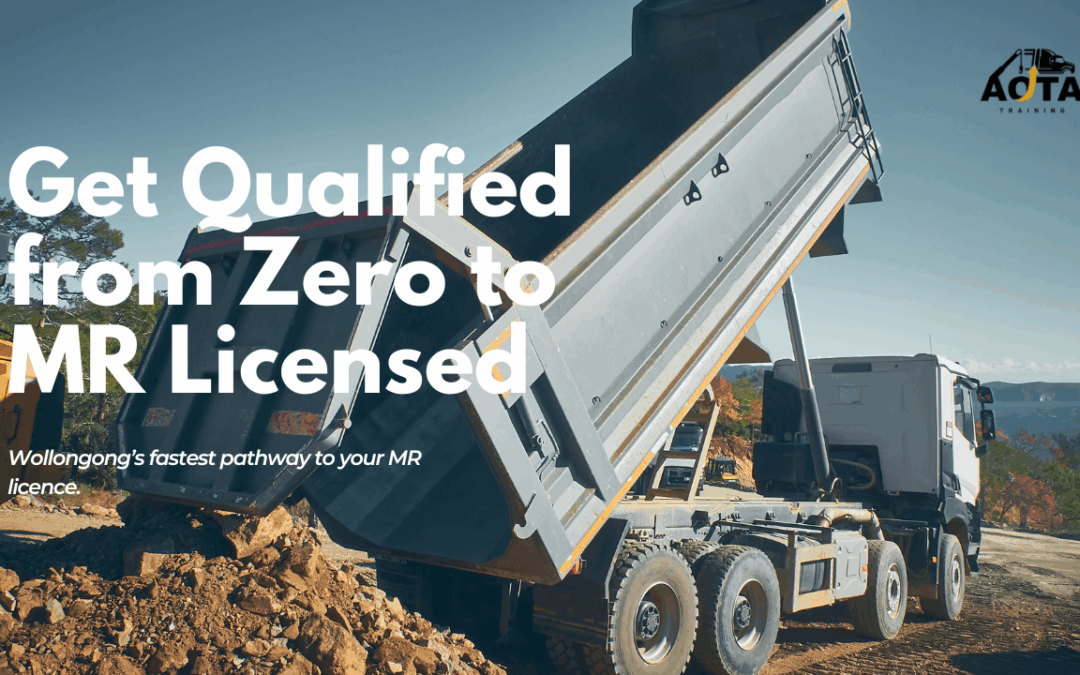
Let’s clear this up right now: YES, you absolutely can get your MR licence with zero prior truck driving experience.

And our 1-day driver training course is the most popular way to do it in the Illawarra.

This guide will bust the biggest myths about truck licensing and show you, step-by-step, how you can go from a standard car licence to a fully qualified MR driver in a single day.


The Biggest Myth About Truck Licensing (Busted!)

The number one myth is that you need “truck experience” to apply.

This is 100% false.

What you actually need is “car experience.” Let’s look at the official entry requirements for your MR Licence and for Transport NSW:

  • You must have held a Class C licence (a car licence), not a learner’s, for at least 12 months.
  • You must pass the MR Driver Knowledge Test (DKT) at a Service NSW centre.
  • You must pass an eyesight test (at Service NSW).
  • You must get your HVCBA Learner Logbook (from Service NSW).

That’s it. Notice what’s not on that list? “Must have driven a truck.” The 12 months you spent on your P-plates and driving your car is all the “experience” the RMS requires.

Your car licence proves you know the road rules. Our job is to teach you how to apply them to a bigger vehicle.


“But I’m a Total Beginner!” — Why Our 1-Day Course is Built for You

We know what you’re thinking. “How can I possibly learn everything in one day?”

It sounds intense, but it’s the most effective way to learn. Our 1-Day course (running 7am to 3pm) isn’t a “1-day assessment” for experienced drivers; it’s a 1-day training program designed specifically to take beginners from zero to hero.

Here’s why it works so well.

1. It’s an Intensive, 1-on-1 Session

This isn’t a big group class where you have to wait for 10 other people to get a turn. This is an intensive, one-on-one session with our friendly, qualified assessor. It’s all about you.

You’re not just getting a 1-hour lesson and sent home. You are with an expert trainer from 7am to 3pm. This continuous, focused time in the cab is the fastest way to build muscle memory and confidence. You get to ask all the “silly” questions, and we won’t move on until you’re 100% comfortable.

2. We Use an Easy-to-Drive “Auto/Synchromesh” Gearbox

This is the secret. Many people are terrified of learning to drive a “Roadranger” or “crash ‘box” gearbox, which is notoriously difficult.

We don’t use them.

Our MR trucks use an Auto or Synchromesh gearbox. What does that mean? Synchromesh means it drives just like a manual car. The gear pattern is simple, and you use the clutch just like you do in your car. There’s no double-clutching, no “finding” the gear. And auto is auto.

This is a massive advantage. Instead of spending 8 hours just fighting the gearbox, you spend your time learning the important skills:

  • Correctly positioning the truck on the road
  • Understanding your turning path and “cut-in”
  • Reversing and manoeuvring in tight spaces
  • Proper braking techniques

3. We Train You for Competency, Not Just to Pass a Test

Our 1-day course is run under the Heavy Vehicle Competency Based Assessment (HVCBA) system. This means our job isn’t to “pass or fail” you like a test. Our job is to train you until you are competent.

The 7am to 3pm day is structured to build your skills step-by-step. You’ll start with the basics (cabin drill, pre-start checks) and progressively move to more complex skills. The final assessment isn’t a separate, scary event; it’s just you demonstrating the skills we’ve been practicing all day. We are on your side, and our goal is to see you succeed.


Your “Zero-to-MR” Checklist: How to Apply as a Beginner

Okay, you’re convinced. You’re a beginner, but you’re ready. Here is your exact 4-step plan to getting your MR licence.

Step 1: Visit Service NSW

This is the only part you have to do before you see us.

  • Go to any Service NSW centre.
  • Tell them you want to start the process for a Medium Rigid (MR) licence.
  • Pass the MR Driver Knowledge Test (DKT). (You can get the practice questions online).
  • Pass the eyesight test.
  • They will give you your HVCBA Learart/Logbook and a “Guide to Heavy Vehicle Competency Based Assessment.”

Step 2: Call AOTA and Book Your 1-Day Course

  • Call us on 02 4206 8378.
  • Tell our team, “I’ve just got my MR logbook, I’m a total beginner, and I’d like to book the 1-day course.”
  • We’ll book you in for a date at our 275a Princes Highway, Unanderra training facility.
  • The all-inclusive, beginner-friendly package (Training & Pricing Schedule)

Step 3: Attend Your 1-Day (7am-3pm) Training Day

  • This is the big day! You’ll arrive at our Unanderra yard at 7am.
  • You’ll meet your trainer and get familiar with the MR truck.
  • You will spend the day covering all the required competencies in your logbook, including pre-start checks, cabin drills, load security, reversing, and a long practical drive to demonstrate your skills.

Step 4: Get Your New Licence!

  • Once you’ve been deemed competent in all criteria, your AOTA assessor will sign off your logbook.
  • You take this completed logbook back to Service NSW.
  • They process your paperwork, take your new photo, and you walk out with your new, upgraded MR licence.
  • Congratulations—you’re now a qualified truck driver.


Your New Career Starts Here (Yes, Even With No Experience)

All those jobs you see in the Illawarra—MR delivery drivers, civil water cart operators for the Mt Ousley and West Dapto projects, local logistics—are now open to you.

The only thing standing between you and that $68k+/year job isn’t “experience”; it’s a 12-month-old car licence and a single 8-hour training day with us.

Stop worrying if you “can” do it. You can, and we’ll show you how.

Ready to book your beginner’s course? Call the AOTA team today on 02 4206 8378 or visit our MR Licence Page to secure your spot.

Ready to unlock your full potential? Explore our Heavy Vehicle Licence Training further to discover the perfect training path for you. Or, if you have any questions or need personalised guidance, don’t hesitate to contact us. Our friendly team is here to support you every step of the way.

Remember, your dream career is within reach. With AOTA by your side, you can build the skills, confidence, and qualifications you need to succeed. So, take the first step today and start building your future!

Dedicated to your success

Nigel

Know the Risk | Interactive Hazard Finder

From high-risk zones to hidden hazards, this interactive tool helps you identify worksite dangers and shows you the safety training to tackle them confidently.

Get Your Hiab (CV) Licence in Wollongong | A Tradie & Driver’s Guide

Get Your Hiab (CV) Licence in Wollongong | A Tradie & Driver’s Guide

The Hiab Ticket: The Smartest Move for Any Driver or Tradie in the Illawarra

From “Just a Driver” to a One-Man-Band

For the longest time, my job has been driving a truck. I drop off building materials to sites all over the Illawarra, from new builds in West Dapto to renovations up in Bulli. And at almost every stop, it was the same story: I’d pull up and then have to wait. Wait for the site foreman, wait for the forklift, wait for the labourers to be free to unload me by hand. All that waiting is time, and time is money.

I kept seeing other trucks, especially from the big steel and timber suppliers, with TLILIC0024 Licence to operate a vehicle loading crane (capacity 10 tonnes and above) (Hiabs) on them. The driver would pull up, set up his outriggers, and have his entire load placed exactly where the builder wanted it in 20 minutes. No waiting, no fuss. He was a self-sufficient unit. That’s when I knew I needed my CV (Vehicle Loading Crane) licence. The Australian transport and logistics industry is facing a skills shortage, but they’re not just looking for drivers; they’re looking for drivers who can solve problems. This ticket is a no-brainer for adding value and getting into those higher-paid, more respected roles.

Why the Hiab is King for Logistics and Trades in Our Area

In a region like the Illawarra, with its mix of tight residential streets, sprawling new estates, and busy industrial areas, the versatility of a Hiab is unmatched.

The Ultimate Problem-Solver

  • For Drivers: Think of all the logistics companies running out of Port Kembla or the building suppliers with yards in Albion Park. A Hiab ticket makes you a premium employee. You can handle deliveries to tricky sites with no forklift access, lifting over fences or onto second-story balconies. You become the solution to the client’s problem.
  • For Tradies: If you’re a builder, plumber, or landscaper, how much time do you waste with manual handling? With a Hiab on your truck, you can lift pipes, timber packs, generators, or bags of soil right where you need them. It saves your back, saves you time, and makes your whole operation look more professional.

The Business Case | Earning More

For an owner-driver, a Hiab is a revenue-generating machine. You can charge a premium for crane truck services. For an employee, it puts you in a higher pay bracket. Companies are willing to pay more for a driver who can do the job of two people (a driver and a crane operator). It also opens up specialised niches, like delivering swimming pools or machinery, which command higher rates.

A Quick Look at What Really Matters in the Course

The formal training for a High-Risk Work Licence like this is about more than just getting the certificate; it’s about understanding the unique dangers of a crane that’s mounted on a truck.

It’s All About Stability

The number one thing they drill into you is stability. A mobile crane has a purpose-built, heavy base. A truck doesn’t. You’ll spend a lot of time learning how to properly deploy the outriggers to create a stable lifting platform. You’ll learn to assess the ground you’re setting up on – is it soft? Is it on a slope? This is something most blogs don’t talk about; the setup is more important than the lift itself.

Understanding the Load Chart on the Fly

Unlike a workshop crane, every single setup with a Hiab is different. The specific load chart changes depending on how far you’ve extended your outriggers. The course teaches you how to read these charts quickly and accurately, ensuring you never try to lift more than the crane can handle in that specific configuration. It’s a crucial, on-the-fly skill that keeps everyone safe.

Reading the Environment

This is a key “insider” skill. Before you even extend the boom, you’re scanning for hazards. Are there powerlines overhead? Are there tree branches in the way? Is there public access that needs to be cordoned off? The course teaches you to develop this “sixth sense” for potential dangers in a constantly changing environment.

Is This Licence Right for You?

This ticket is ideal for the independent problem-solver. Ask yourself:

  • Are you a good planner? Every job requires you to think ahead about where you’ll park, how you’ll set up, and the sequence of your lifts.
  • Do you enjoy working independently? Often, you’ll be on your own, responsible for the entire operation from start to finish.
  • Are you good with clients? You’re the face of the company on-site, so a bit of customer service skill goes a long way.
  • Can you adapt to new challenges? No two job sites are the same. You need to be able to think on your feet.

A Simple Way to Earn More on Every Single Job

For any driver or tradie in the Illawarra, the Hiab ticket is one of the fastest and most cost-effective ways to boost your skills and your pay packet. It makes you more independent, more efficient, and more valuable. It’s about taking charge of your own work and proving you can do the whole job, from transport to placement, all on your own. It’s the definition of working smarter, not harder.

Courses that compliment:

Ready to unlock your full potential? Explore our full range of courses further to discover the perfect training path for you. Or, if you have any questions or need personalised guidance, don’t hesitate to contact us. Our friendly team is here to support you every step of the way.

Remember, your dream career is within reach. With AOTA by your side, you can build the skills, confidence, and qualifications you need to succeed. So, take the first step today and start building your future!

Dedicated to your success

Nigel

Know the Risk | Interactive Hazard Finder

From high-risk zones to hidden hazards, this interactive tool helps you identify worksite dangers and shows you the safety training to tackle them confidently.
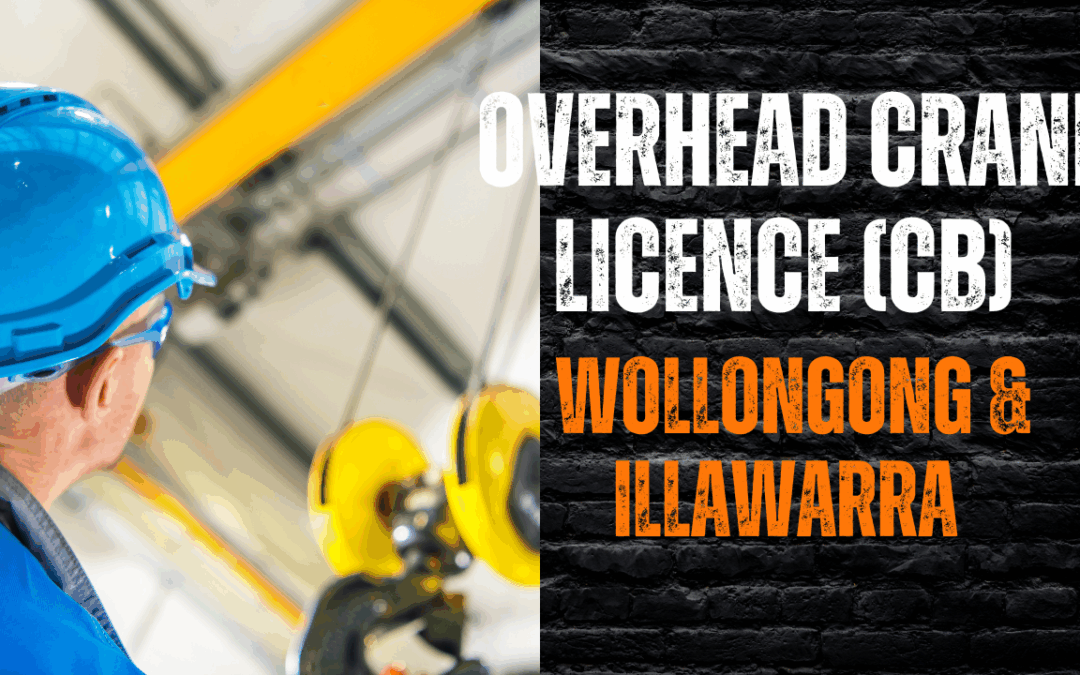
Overhead Crane Licence (CB) in Illawarra | Guide for Workshop Staff

Overhead Crane Licence (CB) in Illawarra | Guide for Workshop Staff

The Unsung Hero of the Workshop: Why I’m Getting my Bridge and Gantry Crane Licence

The Daily Grind of Waiting for a Lift

I’ve spent the last six years in a fabrication workshop in Unanderra. I love the work, but I’ll tell you what drives me mad: waiting. Every day, multiple times a day, our entire workflow comes to a halt. We’ll have a 2-tonne steel beam fabricated and ready to go, but we have to stand around, tools down, waiting for one of the two guys with an overhead crane ticket to be free. It’s a massive bottleneck. You can feel the productivity—and the money—draining away.

I see it as a huge opportunity. With the manufacturing sector in Australia focusing more on high-efficiency and specialised production, being a multi-skilled worker is more valuable than ever. Getting my CB licence (Bridge and Gantry Crane) isn’t just about being able to move something from A to B. It’s about making myself an indispensable part of the team, safer in my own job, and opening doors for future leadership roles. I’ve always had my eye on a job at BlueScope, and a ticket like this is a basic requirement, not a bonus.

The Bridge and Gantry Crane, The Backbone of Illawarra Industry

These aren’t the cranes you see on the news, but they are the workhorses that keep the Illawarra’s industrial heart beating. They are a foundational piece of equipment for our region’s key industries.

Where You’ll Find Them

They are everywhere in our region. From the massive steel manufacturing plants in Port Kembla to the engineering workshops in Fairy Meadow and the countless warehouses dotted around, bridge and gantry cranes are essential. It’s a foundational skill for heavy industry. It tells an employer you’re serious and that you understand the mechanics of a productive and safe workshop.

Career Path and Internal Promotion

This ticket is often the first step towards a supervisory or leading-hand role. When you’re the one who can operate the crane, you naturally start directing the workflow on the floor. You become the go-to person. This leads to more responsibility and, ultimately, a better pay grade. It shows you have initiative and a broader understanding of the workshop’s operations, making you a prime candidate for promotion when a position opens up.

What’s Really Involved in the Training?

What most people don’t think about with overhead cranes is the finesse involved. It’s not like a video game. These machines move thousands of kilos of steel, and your job is to do it with precision and care, often in very tight spaces.

More Than Just Up, Down, Left, and Right

The training dives deep into things you might not consider:

  • Slinging Techniques: You learn how to safely and securely sling a load. What’s the difference between a basket hitch and a choker hitch? How do you find the centre of gravity on an awkward load to stop it from tipping? This knowledge is critical and protects both the product and your workmates.
  • Avoiding “Shock Loading”: Anyone can drop a load, but a professional knows how to land it gently. Abruptly stopping or starting a lift can put immense stress—a “shock load”—on the crane and the rigging. The course teaches you how to feather the controls for a smooth, safe landing.
  • The Importance of Pre-Start Checks: This is a big one. A good operator doesn’t just jump in and go. You learn a rigorous inspection process – checking the wire ropes, the hook, the brakes, and the emergency stop. It’s about creating a safety-first mindset that prevents accidents before they happen. 

Precision Over Power

A key skill you’ll learn is how to manage “load swing.” When you move the crane, the load will want to swing like a pendulum. You learn to anticipate this and make small, precise movements to keep the load steady. This is especially crucial when you’re placing a heavy object onto a machine or a truck with millimetres to spare.

Is This Licence Right for You?

This role is perfect for a certain type of person. Ask yourself:

  • Do you have good attention to detail? This job is all about precision and following procedures perfectly every time.
  • Are you a team player? You’ll be working closely with people on the floor, so clear communication is essential.
  • Do you enjoy a structured environment? Workshop jobs are often about routine and process. This skill fits perfectly into that.
  • Are you proactive about safety? You need to be the kind of person who spots a frayed sling or a potential hazard before it becomes a problem.

Becoming an Essential, Not an Optional, Team Member

With this licence, I’m no longer just another person on the floor waiting for a lift. I become a key player, someone who can keep the workflow moving and contribute directly to the team’s productivity and safety. It’s a straightforward, affordable way to add a formal High-Risk Work Licence to my name and immediately increase my value to any industrial employer in the Illawarra. It’s about taking control of my role and proving I am essential.

Courses that compliment you Overhead Crane Licence:

Ready to unlock your full potential? Explore our website further to discover the perfect training path for you. Or, if you have any questions or need personalised guidance, don’t hesitate to contact us. Our friendly team is here to support you every step of the way.

Remember, your dream career is within reach. With AOTA by your side, you can build the skills, confidence, and qualifications you need to succeed. So, take the first step today and start building your future!

Dedicated to your success

Nigel

Know the Risk | Interactive Hazard Finder

From high-risk zones to hidden hazards, this interactive tool helps you identify worksite dangers and shows you the safety training to tackle them confidently.