

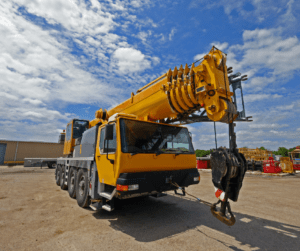
SafeWork NSW Crane Operator Licence Training Wollongong
Launch an elite industrial lifting career or update your enterprise workforce compliance. Master structural stability dynamics, precise outrigger deployment, and heavy lift-chart safety vectors with hands-on machinery seat-time and native SafeWork NSW testing at our specialized Unanderra base.
The AOTA Technical Edge: Real Machine Seat-Time & Native Appraisals
-
Dedicated Heavy Plant Fleet Availability: Forget abstract computer simulation modules. All students gain intensive, high-repetition practical seat-
time behind the active controls of industry-compliant machinery at our Unanderra practical depot (275A Princes Hwy). -
Natively Handled SafeWork NSW Testing: Don’t get caught in third-party scheduling loops. Our internal team features accredited, local high-risk assessors who handle your official written, calculation, and practical testing protocols directly on-site.
-
Rigorous Lift-Plan Safety Physics: Master the vital mechanical engineering fundamentals of the crane stability triangle, ground density constraints, structural outrigger mat allocations, and multi-stage load chart data.
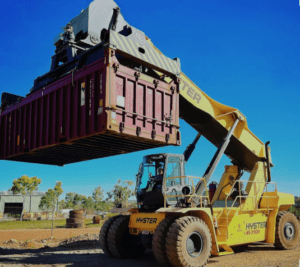
This unit specifies the skills and knowledge required to operate a reach stacker with a Maximum Rated Capacity (MRC) exceeding 3 tonnes safely, in accordance with all relevant legislative responsibilities. Competence in this unit, does not in itself result in a HRWL licence to operate this plant.
Reach stacker means a powered reach stacker that incorporates an attachment for lifting and lowering a shipping container.
This unit applies to the activities of a person operating a reach stacker greater than 3 tonnes capacity that incorporates an attachment for lifting, moving and travelling with a shipping container (not including a shore based container handling gantry crane).
A person performing this work is required to hold a reach stacker High-Risk Work Licence (HRWL)
This unit requires a person operating reach stacker with an MRC exceeding 3 tonnes to:
- plan the work/task
- prepare for the work/task
- perform work/task
- Pack up
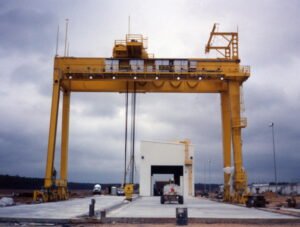
This unit specifies the skills and knowledge required to operate bridge cranes and gantry cranes safely. Competence in this unit, does not in itself result in a High-Risk Work Licence (HRWL) to operate this plant.
Bridge crane means a crane that:
- consists of a bridge beam or beams, that are mounted to end carriages at each end, and
- can travel along elevated runways, and
- has one or more hoisting mechanisms arranged to traverse across the bridge.
Gantry crane means a crane that:
- consists of a bridge beam or beams supported at one or both ends by legs mounted to end carriages, and
- can travel on supporting surfaces or deck levels, whether fixed or not, and
- has a crab with one or more hoisting units arranged to travel across the bridge
This unit applies to the activities of a person operating a bridge crane or gantry crane that is:
- controlled from a permanent cabin or control station on the crane, or
- remotely controlled and having more than three powered operations.
A person performing this work is required to hold a bridge and gantry crane HRWL.
This unit requires a person operating a bridge crane or gantry crane to:
-
- plan for the work/task
- prepare for the work/task
- perform work/task
- pack up.
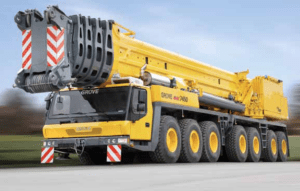
This unit specifies the skills and knowledge required to safely operate a slewing mobile crane with a Maximum Rated Capacity (MRC) over 100 tonnes in accordance with all relevant legislative responsibilities. Competence in this unit, does not in itself result in a High-Risk Work Licence (HRWL) to operate this plant.
Slewing mobile crane means a mobile crane incorporating a boom or jib that can be slewed, but does not include:
- a front-end loader, or
- a backhoe, or
- an excavator, or
- other earth moving equipment, when configured for crane operation.
A person performing this work is required to hold a slewing mobile crane with an MRC over 100 tonnes HRWL.
This unit requires a person operating a slewing mobile crane with an MRC over 100 tonnes to:
- plan for the work/task
- prepare for the work/task
- perform work/task
- pack up.
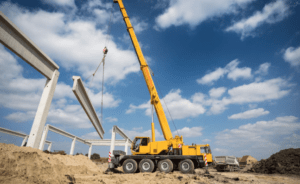
This unit specifies the skills and knowledge required to safely operate a slewing mobile crane with a Maximum Rated Capacity (MRC) up to 100 tonnes, in accordance with all relevant legislative responsibilities. Competence in this unit, does not in itself result in a High-Risk Work Licence (HRWL) to operate this plant.
Slewing mobile crane means a mobile crane incorporating a boom or jib that can be slewed, but does not include:
- a front-end loader, or
- a backhoe, or
- an excavator, or
- other earth moving equipment, when configured for crane operation.
A person performing this work is required to hold a slewing mobile crane with an MRC up to 100 tonnes HRWL.
This unit requires a person operating a slewing mobile crane with an MRC up to 100 tonnes to:
-
- plan for the work/task
- prepare for the work/task
- perform work/task
- pack up.
This unit specifies the skills and knowledge required to safely operate a slewing mobile crane with a Maximum Rated Capacity (MRC) up to 20 tonnes in accordance with all relevant legislative responsibilities. Competence in this unit, does not in itself result in a High-Risk Work Licence (HRWL) to operate this plant.
Slewing mobile crane means a mobile crane incorporating a boom or jib that can be slewed, but does not include:
- a front-end loader, or
- a backhoe, or
- an excavator, or
- other earth moving equipment, when configured for crane operation.
A person performing this work is required to hold a slewing mobile crane with a MRC up to 20 tonnes HRWL.
This unit requires a person operating a slewing mobile crane with an MRC up to 20 tonnes to:
- plan for the work/task
- prepare for the work/task
- perform work/task
- pack up.
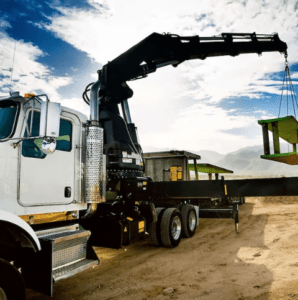
This unit specifies the skills and knowledge required to safely operate a vehicle loading crane with a Maximum Rated Capacity (MRC) of 10 metre tonnes or more. Competence in this unit, does not in itself result in a High-Risk Work Licence (HRWL) to operate this plant.
Vehicle loading crane means a crane mounted on a vehicle for loading and unloading the vehicle.
A person performing this work is required to hold a vehicle loading crane HRWL.
This unit requires a person operating a slewing vehicle loading crane with a MRC of 10 metre tonnes or more to:
- plan for the work/task
- prepare for the work/task
- perform work/task
- pack up.
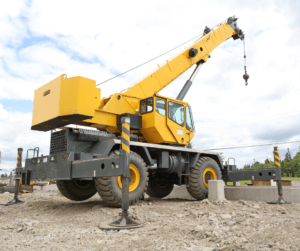
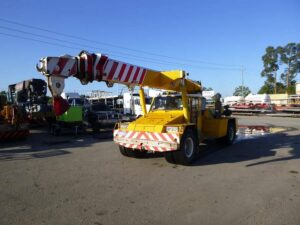
This unit specifies the skills and knowledge required to operate a non-slewing mobile crane with a Rated Capacity (RC) exceeding three tonnes safely, in accordance with all relevant legislative responsibilities. Competence in this unit, does not in itself result in a High Risk Work Licence (HRWL) to operate this plant. Competence in this unit does not allow for driving an articulated mobile crane on a main or public road. In order to drive on a main or public road, a valid heavy vehicle licence, issued by a transport regulator, is required.
Non-slewing mobile crane means a mobile crane incorporating a boom or jib that cannot be slewed, and includes:
- an articulated mobile crane
- a locomotive crane
- but does not include vehicle tow trucks.
A person performing this work is required to hold a non-slewing mobile crane HRWL.
This unit requires a person operating non-slewing mobile crane with an RC exceeding three tonnes to:
- plan the work/task
- prepare for the work/task
- perform work/task
- prepare to drive an articulated mobile crane on road
- drive an articulated mobile crane
- pack up.
Q: Does a Slewing Mobile Crane licence (such as Class C6) legally permit me to operate non-slewing units?
A: Yes. Under the SafeWork NSW high-risk work infrastructure, holding a valid Slewing Mobile Crane licence (Class C2, C6, C1, or C0) provides built-in operational coverage for lower-tier classifications. This means a valid C6 licence legally authorises you to operate any Non-Slewing Mobile Crane (CN) or Vehicle Loading Crane (CV) nationwide.
Q: What unique mathematical metrics are evaluated during the formal crane licensing test?
A: Crane operations involve considerable safety math. The mandated SafeWork NSW assessment features a dedicated calculations section where you must demonstrate total precision in estimating structural load weights, determining the center of gravity on irregular shapes, calculating the derated Working Load Limit (WLL) of rigging configurations, and extracting correct parameters from diverse crane load charts.
Q: What original identity and protective clothing parameters must I comply with on training morning?
A: SafeWork NSW strictly mandates that all high-risk candidates must be a minimum of 18 years of
Or Call Us on: 02 42068378
Office Hours: 9am-5pm
Add a Forklift Licence
Become the ultimate multi-skilled operator employers actively look for who hold a forklift licence, allowing them to legally load and unload equipment in the yard or onsite
Get Your EWP Ticket (11m+)
Expand your high-reach capabilities. Many construction roles require operators to hold both a forklift licence and an Elevating Work Platform ticket.