




Call Us

02 42068378
Office Hours: 9am-5pm

logo 1
Rigging vs. Dogging | The 2026 Career Roadmap to Earning Top Dollar

Rigging vs. Dogging | The 2026 Career Roadmap to Earning Top Dollar

If you have spent a few months on a construction site in the Illawarra, you have probably noticed a hierarchy. There are the laborers, there are the trades, and then there are the Riggers.

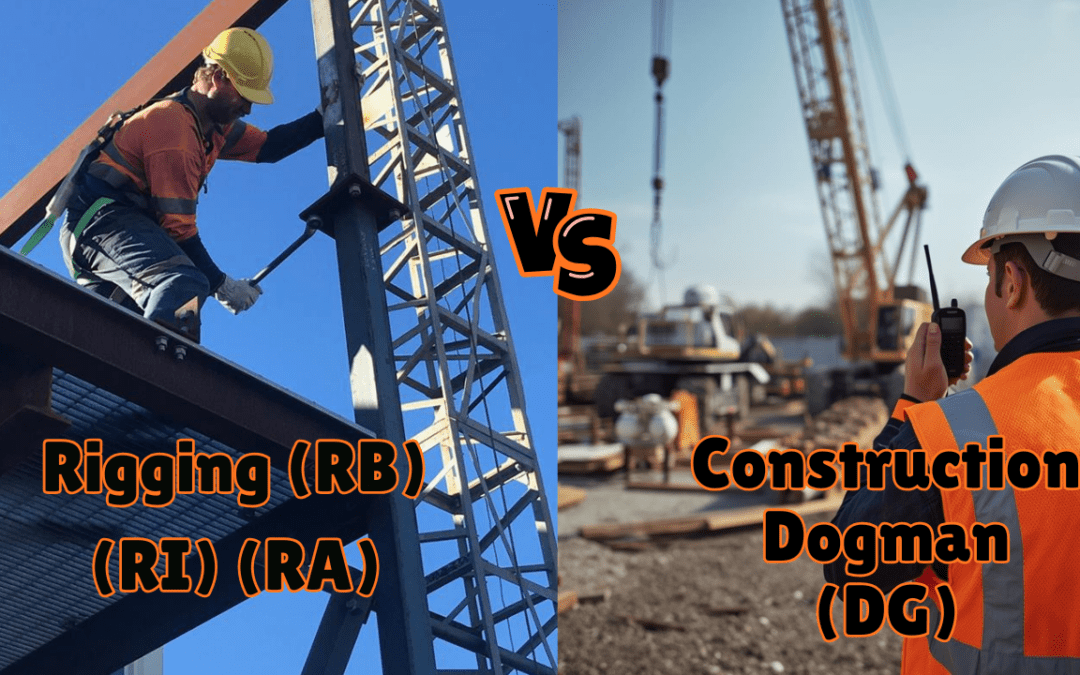
Rigging is often viewed as the “Dark Art” of the construction world. While the Dogman directs the crane, the Rigger is the one calculating the impossible, erecting the steel skeleton of the building, and moving plant equipment that weighs more than a house.

As we head into 2026, with major industrial projects like the BlueScope transformation and the Shoalhaven Hospital redevelopment ramping up, the demand for dual-ticketed (Dogging + Rigging) operators is skyrocketing.

But for those just starting out, the terminology can be confusing. What is the difference between Dogging and Rigging? Do you need one to get the other? And most importantly, which one pays more?

In this guide, we map out the complete pathway from “Green” to “Advanced Rigger,” with specific dates for our January 2026 intakes at Unanderra.

The Foundation: It All Starts with Dogging (DG)

You cannot build a house without a slab, and you cannot become a Rigger without first being a Dogman.

The Licence to Perform Dogging (CPCCLDG3001) is the prerequisite for all Rigging courses.

  • The Rule: You must hold a current DG ticket (or be enrolled in the course) before you can sit the Basic Rigging course.

  • The Logic: Rigging involves complex lifting. If you don’t know how to select a sling or direct a crane (which you learn in Dogging), you aren’t safe to start erecting steel.

Pro Tip: If you are completely new, we recommend booking our Dogging course first, then immediately following it up with Rigging.

Level 1: Basic Rigging (RB) – The Steel Erector

Once you have your Dogging ticket, the next step is Basic Rigging (CPCCLRG3001). This is the “bread and butter” ticket for general construction.

What You Learn: While Dogging is about moving loads, Basic Rigging is about securing and assembling them.

  1. Steel Erection: You will learn how to bolt together structural steel columns and beams. This is the core skill for working on high-rise buildings and industrial sheds.
  2. Cantilevered Crane Loading Platforms (CCLP): Those platforms you see sticking out of skyscrapers to land materials? You learn to install them.
  3. Winches & Gin Poles: Old school skills that are still vital when a crane can’t reach the area.

The Job Market: With an RB ticket, you stop being just a “hook hand” and become a steel erector. This instantly makes you more valuable to structural steel companies and general builders in the Illawarra.

Level 2: Intermediate Rigging (RI) – The Heavy Lifter

This is where the boys are separated from the men. Intermediate Rigging (CPCCLRG3002) takes you away from simple steel erection and into complex, heavy lifts.

The Core Skills:

  • Dual Crane Lifts: Lifting a load with two cranes simultaneously. This requires precise calculation and coordination.

  • Tilt-Up Panels: This is huge in commercial warehousing (like the new logistics hubs in Kembla Grange). You learn to safely rotate and stand up massive concrete wall panels.

  • Demolition Rigging: Safely dismantling structures.

Why Get It? If you want to work on major industrial shutdowns or mine sites, RI is often the minimum standard. It shows you can handle “non-standard” lifts.

Level 3: Advanced Rigging (RA) – The Specialist

The Advanced Rigging (CPCCLRG4001) ticket is the PhD of the lifting world. It covers specialised equipment that terrifies most normal people.

The Core Skills:

  • Hung Scaffolds & Suspended Stages: rigging platforms that hang from the building rather than standing on the ground.

  • Gin Poles & Shear Legs: Complex leverage systems used when cranes are not an option.

This ticket is essential for anyone wanting to work in specialised maintenance, bridge building, or high-rise facade installation.

The “Combo” Strategy: How to Fast-Track Your Income

In 2026, the smartest operators aren’t just doing one course at a time with six months in between. They are doing “Block Training.”

By completing your Dogging  and Basic Rigging  back-to-back at AOTA, you enter the workforce  as a “Dual Ticketed” operator.

Why Employers Love This:

  • You can sling the load (Dogging).

  • You can bolt it up (Rigging).

  • You are useful 100% of the time, not just when the hook is down.

Bonus: The C6 Crane Ticket

For those who want to get off the ground and into the seat, the Slewing Mobile Crane (up to 60 tonnes) – TLILIC0023 is the logical next step.

Being a Rigger who can also jump in the crane seat when needed makes you “unfireable” on many crews.

Train with the Best in the Illawarra

At AOTA, our Unanderra facility is set up for high-risk work. We don’t just read from a textbook.

  • Real Cranes: We train on real slewing mobile cranes, not simulators.

  • Real Steel: You will erect actual steel structures during your RB assessment.

  • Real Experience: Our trainers have worked on the biggest shutdowns and construction projects in Australia.

Don’t spend 2026 wondering “what if.” Get the ticket, get the skills, and get the pay rate you deserve

Ready to unlock your full potential? Explore our available courses further to discover the perfect training path for you. Or, if you have any questions or need personalised guidance, don’t hesitate to contact us. Our friendly team is here to support you every step of the way.

Remember, your dream career is within reach. With AOTA by your side, you can build the skills, confidence, and qualifications you need to succeed. So, take the first step today and start building your future!

Dedicated to your success

Nigel

Know the Risk | Interactive Hazard Finder

From high-risk zones to hidden hazards, this interactive tool helps you identify worksite dangers and shows you the safety training to tackle them confidently.
How to Get Your CPCCLDG3001: Licence to Perform Dogging in NSW in 2026

How to Get Your CPCCLDG3001: Licence to Perform Dogging in NSW in 2026

The Ultimate Guide to Getting Your Dogman Ticket in NSW (2026 Edition)

If you have spent any time on a construction site in the Illawarra lately, you know the story. The crane is swinging, the site is buzzing, and the person with the whistle and the radio is calling the shots. That person is the Dogman. And right now, in 2026, they are one of the most in-demand professionals in NSW.

With massive infrastructure projects kicking off—from the BlueScope land transformation to the Renewable Energy Zone (REZ)—recruiters are scrambling for qualified operators. But they aren’t just looking for bodies; they are looking for ticketed professionals who know what they are doing.

If you are currently laboring for $30 an hour and looking at the guys in the high-vis vests earning $50+ an hour, this guide is for you. We are going to break down exactly how to get your Dogman Ticket (officially known as the CPCCLDG3001 Licence to Perform Dogging), what the course involves, and how to make sure you don’t just pass the test, but actually get the job.

“Ticket” vs. “Licence”: What’s the Difference?

Before we dive into the training, let’s clear up the confusion that floods our inbox every week.

  • “I need my Dogman ticket.”

  • “Do you do the Dogging licence?”

  • “Is the High Risk Work card the same thing?”

The short answer: Yes, they are all the same thing.

In the industry, everyone calls it a “Ticket.” On the paperwork and SafeWork NSW legislation, it’s called a “High Risk Work Licence (HRWL).”

When you complete your training with a Registered Training Organisation (RTO) like AOTA, you aren’t just getting a piece of paper; you are applying for a nationally recognised licence issued by SafeWork NSW. This licence is valid for 5 years and allows you to work on any site in Australia.

Why the “Dogman” is the Most Critical Job on Site

A lot of people think the crane operator is the boss of the lift. They’re wrong. The crane operator is often working blind, relying 100% on the eyes, ears, and judgment of the Dogman.

The technical side (slinging)

If the Dogman miscalculates the weight of a steel beam, picks the wrong sling, or gives a confusing radio signal, people die. It is that simple. That is why this is classified as “High Risk Work.”

However, with that responsibility comes the reward. Because the safety of the site rests on your shoulders, the pay rates reflect it. In the Illawarra region, entry-level Dogmen can expect significantly higher wages than general laborers, with experienced operators commanding premium rates, especially on union sites or night shifts.

The Prerequisites: Can Anyone Do It?

You don’t need a university degree or a background in engineering to be a great Dogman. In fact, some of the best operators we’ve trained were former chefs, truck drivers, or general laborers.

To enrol in the course, you only need three things:

  1. Age: You must be 18 years or older.
  2. Language: You must have a basic command of the English language (SafeWork NSW requires you to complete the assessment in English).
  3. ID: You need 100 points of ID (e.g., Passport, Driver’s Licence, Medicare Card).

Note: You do NOT need your White Card to do the course, but you WILL need it to step onto a construction site to work.

The 5-Day Course Breakdown: What Actually Happens?

At AOTA, we don’t believe in “Tick and Flick” courses. We run a comprehensive 5-day program at our Unanderra facility designed to take you from “green” to “site-ready.”

Here is what your week will look like:

Days 1-2: The Theory & The Maths (Don’t Panic!)

The first two days are classroom-based. This is where we cover the “Plan Work” component.

  • The Maths: This is the part that scares most people. You will learn to calculate the Working Load Limit (WLL) of flexible steel wire rope, chains, and synthetic slings.

  • The Myths: You don’t need to be a math genius. If you can use a calculator (which we provide) and follow a formula, you will be fine. Our trainers are experts at breaking this down simply.

  • Safety: Understanding the hierarchy of control, hazard identification, and how to read a load chart.

Days 3-4: The Practical (Getting Hands-On)

This is where the fun starts. You get out of the classroom and into the yard.

  • Slinging Loads: You will get hands-on with chains, tags, shackles, and snatch blocks. You’ll learn how to inspect gear for defects—a skill that will save your life one day.

  • Directing the Crane: We put you on the radio. You will practice guiding a slewing mobile crane operator to move loads through obstacles, landing them precisely on targets. You’ll learn the standard whistle signals and hand signals that are the universal language of Australian construction sites.

  • The “Simulation”: Unlike other schools that might use a dummy load in a warehouse, we simulate real site conditions. You’ll deal with wind, obstacles, and the pressure of efficient communication.

Day 5: The Assessment

The final day is assessment day. SafeWork NSW requires you to pass three components:

  1. Knowledge Assessment: A written or verbal test covering the theory.
  2. Calculations Assessment: Proving you can do the maths to lift safely.
  3. Performance Assessment: A practical test where you sling a load and guide a crane through a complex task while an assessor watches.

The “Experience Catch-22” (And How to Beat It)

We hear it all the time: “I’ve got my ticket, but no one will give me a start because I don’t have experience.”

This is the biggest hurdle in the industry. Employers are terrified of hiring “green” operators who might damage a $500,000 load or injure a worker.

This is the AOTA difference. Because our training is known for being rigorous and realistic, employers in the Illawarra trust the AOTA brand. When you finish our course, you haven’t just sat in a room; you’ve sweated in the yard.

Pro Tip for Getting Hired: Don’t just email your resume. Walk onto site or into the labour hire office. Show them your shiny new HRWL card and say: “I trained at AOTA. I know my load charts, I know my knots, and I’m ready to do a VOC (Verification of Competency) right now.” Confidence sells.

Beyond the Dogman Ticket: The Career Pathway

Getting your Dogging ticket is just the first step. It is the “Gateway Ticket” that opens the door to the rest of the High Risk Work industry.

Once you have your Dogman (DG) ticket, you can progress to:

Ready to Upgrade Your Paycheck?

2026 is moving fast. The projects are approved, the cranes are going up, and the recruiters are hiring. Don’t sit on the sidelines watching the action.

Next Course Dates: We run Dogging courses regularly at our Unanderra facility. Spaces fill up fast (usually 2-3 weeks in advance).

[Click here to view the Training Schedule and Secure Your Spot]

Don’t wait for the “perfect time.” The best time to get ticketed was yesterday. The second best time is today.

Ready to unlock your full potential? Explore our course library further to discover the perfect training path for you. Or, if you have any questions or need personalised guidance, don’t hesitate to contact us. Our friendly team is here to support you every step of the way.

Remember, your dream career is within reach. With AOTA by your side, you can build the skills, confidence, and qualifications you need to succeed. So, take the first step today and start building your future!

Dedicated to your success

Nigel

Know the Risk | Interactive Hazard Finder

From high-risk zones to hidden hazards, this interactive tool helps you identify worksite dangers and shows you the safety training to tackle them confidently.