




Call Us

02 42068378
Office Hours: 9am-5pm

logo 1
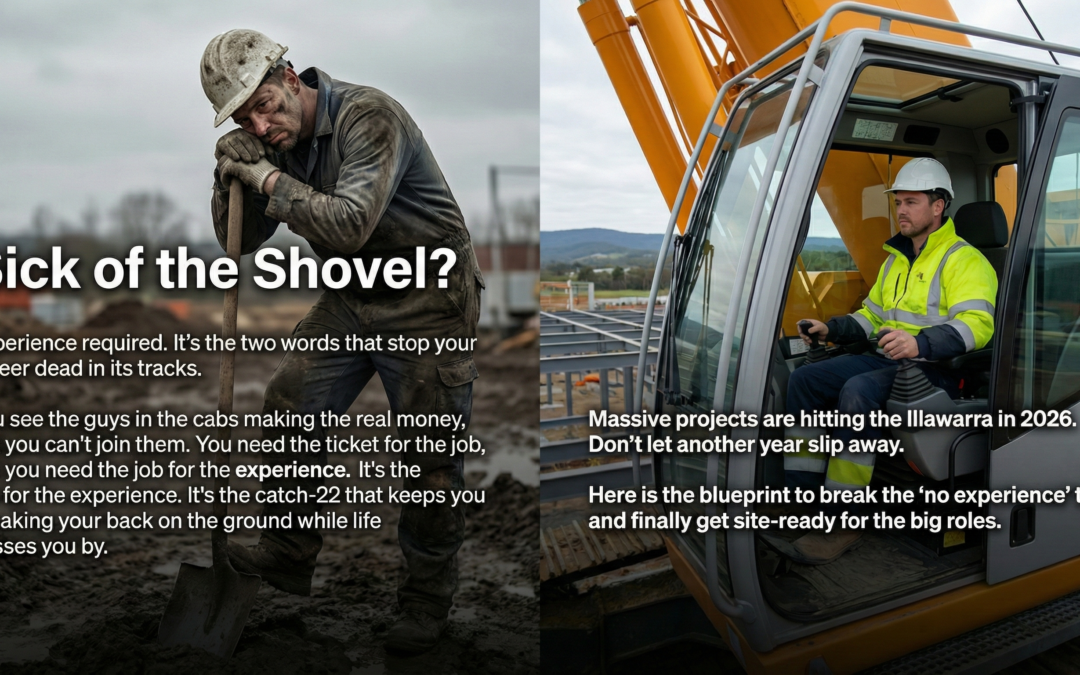
The “Experience Catch-22” is Killing Your Earnings | How to Break Into the 2026 Illawarra Boom

The “Experience Catch-22” is Killing Your Earnings | How to Break Into the 2026 Illawarra Boom

It’s the phone call every labourer in the Illawarra hates making.

You see the ad on Seek or hear about a start from a mate. The money is good—$50 an hour, plus travel, plus penalties. The site is local. You’ve got the White Card, the PPE, and the work ethic. You’re ready to go.

So you ring the foreman or the recruiter. The chat goes well until they ask the killer question:

“How many hours have you got on the crane?” or “How long have you been dogging?”

You’re honest. You say, “I’m looking for a start so I can get the experience.”

The tone changes instantly. “Sorry mate, we need someone who can hit the ground running. Insurance won’t let us take on green guys. Call us when you’ve got two years under your belt.”

Click.

This is the Experience Catch-22: You can’t get the job without the ticket and the experience, but no one will give you a start so you can get the experience.

So, you go back to the shovel. You go back to “dead-end labouring,” breaking your back for $32/hr while watching the ticketed operators sit in air-conditioned cabs earning double your wage.

But here is the reality check: 2026 is going to change the rules of the game in the Illawarra, and you cannot afford to be stuck on the wrong side of the fence.

Market Intel – Why 2026 is Different

We are staring down the barrel of one of the biggest infrastructure shifts the Illawarra has seen in decades. This isn’t just standard residential construction; this is heavy industrial transformation.

If you drive past Port Kembla today, you are looking at the future ground zero of NSW industry.

  1. The BlueScope Land Transformation – With over 200 hectares of surplus land being rezoned and redeveloped, we are talking about massive civil works, warehousing, and logistics hubs.
  2. The No. 6 Blast Furnace Reline – These massive maintenance projects require an army of Riggers, Doggers, and Scaffolders working around the clock.
  3. The Illawarra Renewable Energy Zone (REZ) – As the wind farm logistics ramp up, the demand for heavy lifting and load shifting will skyrocket.

The “Ghost Job” Reality

Right now, you see ads saying “Willing to Train.” Most of these are what we call “Ghost Jobs.” HR departments post them to gather resumes just in case, but when the pressure is on, they never hire the trainee. They hire the guy who is ready now.

When these 2026 projects kick off, they won’t have time to hold your hand. They need operators who are “Plug and Play.”

The Trap – The “Tick and Flick” Disaster

When you realise you need a ticket to get ahead, you might be tempted to find the cheapest, fastest course possible. You know the ones—the “Tick and Flick” joints that promise to get you the piece of paper in a day or two.

This is a career-killing mistake.

Here is the secret recruiters won’t tell you: The ticket gets you the interview, but the VOC gets you the job.

A VOC (Verification of Competency) is a practical test you do on your first morning on site. The safety officer will put you in the seat or hand you the whistle and say, “Show me you can do this safely.”

If you went to a “Tick and Flick” school:

  • You won’t know how to confidently calculate the Working Load Limit (WLL).

  • You’ll fumble with the sling selection.

  • You’ll look nervous.

Result: You are walked off site before lunch. Your name gets marked as “unsafe” in their system. That cheap course just cost you a $100k job.

The AOTA Difference – We Simulate the Job Site

This is where AOTA (All Onsite Training and Assessment) changes the math. We don’t just teach you to pass a SafeWork test; we are building the bridge between “Green” and “Site Ready.”

Located right here in the Illawarra (Unanderra), our facility is designed to break the Experience Catch-22.

1. It’s Not a Classroom, It’s a Simulation

We don’t teach from a textbook in an air-conditioned room all day. We are in the yard. We are using real cranes, real loads, and real steel. When you train with us, you are logging hours that simulate the actual pressure of a site.

2. Trainers Who Have “Done the Time”

Our instructors aren’t academics. They are veterans who have run crews on the biggest sites in Australia. They teach you the “unwritten rules”—how to talk to a crane driver over the radio, how to spot a hazard before it happens, and how to work efficiently without cutting corners.

3. The “AOTA Stamp” Means Something

Local employers know AOTA. When they see our name on your training history, they know you haven’t just bought a ticket—you’ve earned it. That reputation helps you bypass the “no experience” filter.

How to Beat the Catch-22 (Your Strategy)

Once you get your ticket with AOTA, don’t just email your resume. Here is how you get the start:

  1. Show Up – Go to the site office or the labour hire depot in person.
  2. Own Your Training – Say this: “I’ve just got my Dogging ticket through AOTA. I haven’t got 2 years on site, but I’ve been trained properly on real loads, I know my load charts, and I’m ready to pass a VOC today.”
  3. Offer the “Free Trial” – Tell them, “Put me on for a day. If I’m not safe and useful, don’t pay me.” (They will rarely take you up on not paying, but the confidence usually gets you the job).

2026 is Coming. Don’t Be Left Holding the Shovel.

The “Experience Catch-22” is real, but it can be beaten. The only way to break the cycle is to force the door open with a High Risk Work licence that proves you are an asset, not a liability.

Don’t wait until the projects start and the courses are booked out. Invest in yourself now.

Ready to upgrade your paycheque?

Check out our 2026 courses  or drop into our facility in Unanderra to see how we train the best.

Ready to unlock your full potential? Explore our website further to discover the perfect training path for you. Or, if you have any questions or need personalised guidance, don’t hesitate to contact us. Our friendly team is here to support you every step of the way.

Remember, your dream career is within reach. With AOTA by your side, you can build the skills, confidence, and qualifications you need to succeed. So, take the first step today and start building your future!

Dedicated to your success

Nigel

Know the Risk | Interactive Hazard Finder

From high-risk zones to hidden hazards, this interactive tool helps you identify worksite dangers and shows you the safety training to tackle them confidently.
From the Ground Up | Essential Licences for High-Rise Construction Jobs in the Illawarra

From the Ground Up | Essential Licences for High-Rise Construction Jobs in the Illawarra

Look up. Across Wollongong, Shellharbour, and down to the Shoalhaven, you’ll see them: the towering skeletons of cranes, the steady rise of new floors, the buzz of activity that signals growth. These aren’t just buildings; they’re vertical cities of opportunity. Projects like the massive Shoalhaven Hospital Redevelopment and the state-of-the-art UOW-Dragons Centre are more than just concrete and steel—they are complex, multi-year operations that require hundreds of skilled, qualified workers.  

But how do you go from being the person on the street looking up, to the person on-site building up? It’s not about luck; it’s about having the right skills and, crucially, the right tickets. This isn’t just about ticking boxes. The Australian construction industry is facing a productivity challenge costing the economy billions annually. A huge part of solving that is having a workforce that is not just present, but proficient, safe, and certified.   

This guide is your roadmap. We’re going to break down what really happens on a major commercial building site in the Illawarra and show you the exact training you need to get your foot in the door and build a real career.

Phase 1 | The Ground Game – Setting the Stage

Before a single steel beam is lifted, a massive amount of work happens at ground level. This is the foundation, both literally and for your career. Getting this stage right is everything.

 Your Key to the Gate | The Construction White Card

Let’s be crystal clear: without this, you’re not getting past the front gate. The Construction White Card (CPCCWHS1001 Prepare to work safely in the construction industry) is the absolute, non-negotiable first step. It’s not just a formality; it’s a foundational course that covers essential safety principles, how to identify hazards, and what to do in an emergency. Think of it as your passport to every single construction site in Australia.

 The Earthmovers | Shaping the Site

Once the surveyors have marked out the site, the big machines roll in. This isn’t just about digging a hole; it’s a precise operation.

  • What you’ll see: Excavators performing bulk earthworks, loaders moving soil and materials, and smaller skid steers handling the detailed work around foundations and services.
  • What you’ll need: This is where your plant operation skills become your ticket to consistent work. Holding a qualification for Excavator Operations, Skid Steer Operations, and Front End Loader Operations makes you incredibly versatile during this busy initial phase.

Going Vertical | The World of High-Risk Work

This is where the skyline starts to change. The second a load is lifted by a crane, or a worker steps onto a boom lift, the site enters the realm of High-Risk Work. These activities are so potentially dangerous that they are governed by strict laws, and you must hold a specific High-Risk Work Licence (HRWL) to perform them. This is where you can build a specialised, in-demand career.

The Crane’s Choreographer | Dogging & Rigging

Most people see the crane operator, but they often miss the most critical person on the ground: the dogger or rigger. They are the brains of the lifting operation.

  • What’s the difference? A Dogger is the crane’s eyes and ears. They are responsible for assessing the load, choosing the correct slinging technique, and directing the crane operator with hand signals or radio commands. A Rigger does everything a dogger does, but they are also qualified to handle more complex tasks, like erecting and dismantling cranes and scaffolding, working with tilt-up panels, and performing dual crane lifts.
  • The Pathway: You start with a Dogging (DG) licence. From there, you can progress to Basic Rigging (RB), Intermediate Rigging (RI), and Advanced Rigging (RA), with each ticket opening up more complex and higher-paying work.
  • Why it’s critical: With around 60% of crane incidents in Australia attributed to human error, the skill of the person slinging the load is paramount. This isn’t a job you can learn by watching; it requires formal, assessed training.  

Reaching for the Sky | EWPs and Height Safety

As the building grows, so does the need to work safely off the ground.

  • Working at Heights: This ticket is essential for almost everyone on a multi-story site, from steel erectors to plumbers and electricians. It teaches you how to use fall arrest systems like harnesses and anchor points correctly.
  • Elevating Work Platforms (EWP): For operating a boom-type EWP where the boom can extend 11 metres or more, you need a specific High-Risk Work Licence (WP). This is one of the most in-demand tickets on commercial sites. Don’t confuse this with the Yellow Card for operating scissor lifts or smaller platforms under 11 metres!

The Final Stretch | Enclosing and Fitting Out

With the structure up, the focus shifts to making it a functional building. This involves installing facades, windows, internal walls, and all the essential services.

  • What you’ll see: Teams working on the building exterior from EWPs, and inside in service risers, ceiling spaces, and plant rooms.
  • What you’ll need: Your Working at Heights ticket remains essential. This is also where Confined Space Training becomes critical. A service duct, a lift well, or a water tank might not look like a confined space, but they are, and they pose invisible risks like atmospheric hazards. Having this qualification makes you a valuable asset during the fit-out phase.

The Safety Net | Skills for Every Single Person on Site

Some skills aren’t tied to a specific phase; they’re about the human element of keeping a site safe.

When Seconds Count, First Aid

On a busy site, accidents—from minor cuts to serious injuries—can and do happen. Being the person who can confidently step in and administer first aid while waiting for paramedics is an invaluable skill. A Provide First Aid certificate makes you a designated first aid officer, a role every work crew needs.

The Hazard You Can’t See, Mental Health

This is the topic most blogs won’t touch, but it’s the most important. The statistics are sobering: Australian construction workers are six times more likely to die by suicide than from a workplace accident. The pressures of the job are immense.  

  • What it is: Mental Health First Aid training doesn’t teach you to be a therapist. It teaches you to be a supportive colleague. It gives you the skills to notice when a mate is struggling, the confidence to ask “Are you okay?”, and the knowledge to guide them towards professional help.  
  • Why it matters: In an industry that is losing too many good people, being a trained Mental Health First Aider makes you a leader in creating a safer, more supportive site culture.

Building a career in commercial construction is a step-by-step process. It starts with a White Card and builds from there with the specific plant, high-risk, and safety qualifications that match your goals.

References:

  • Shoalhaven Hospital Redevelopment Project Update, May 2025.  
  • UOW-Dragons Community and High Performance Centre Construction Announcement, March 2025.  
  • Australian Constructors Association, ‘Nailing Construction Productivity’ Report.  
  • MATES in Construction, Mental Health Awareness Statistics.  
  • All Onsite Training and Assessment, Mental Health First Aid Course Information.  

Ready to unlock your full potential? Explore our website further to discover the perfect training path for you. Or, if you have any questions or need personalised guidance, don’t hesitate to contact us. Our friendly team is here to support you every step of the way.

Remember, your dream career is within reach. With AOTA by your side, you can build the skills, confidence, and qualifications you need to succeed. So, take the first step today and start building your future!

Dedicated to your success

Nigel

Know the Risk | Interactive Hazard Finder

From high-risk zones to hidden hazards, this interactive tool helps you identify worksite dangers and shows you the safety training to tackle them confidently.

Interactive Illawarra Construction Career Guide

Interactive Guide to Illawarra Construction Careers

Build Your Future in the Illawarra

The Illawarra region is experiencing a historic, long-term construction boom. This web application is your interactive guide to understanding the projects, the required skills, and the career pathways available right now.

Investment in Wollongong CBD

Transforming the city center into a modern business hub.

0

Projected Population Growth

Driving demand for new housing, infrastructure, and services by 2041.

0

Potential New Jobs

In advanced manufacturing and clean energy at Port Kembla.

A Pipeline of Major Projects

Strategic government and private investment are funding a diverse range of large-scale projects, ensuring stable, long-term demand for skilled workers across the region.

Interactive Project Map

From major highway upgrades to hospital redevelopments and industrial transformations, the Illawarra is a hive of activity. Click on the project hotspots below to learn more about the key sites shaping our region.

Wollongong & Northern Illawarra

Port Kembla & Shellharbour

Shoalhaven

Find Your Role: An Interactive Guide

A major construction project moves through distinct phases, each requiring a specific set of skills and qualifications. Select a phase below to explore the common tasks and the essential tickets you'll need to get on site.

Build Your Career Pathway

The construction industry offers clear, structured career paths. Advancement is driven by experience and formal qualifications. Click each step below to see how you can progress from an entry-level role to senior management.

1

Entry Level

2

Team Leader / Supervisor

3

Project Management

The Illawarra Job Market Today

The demand for qualified professionals is real and immediate. The examples below, based on recent job advertisements, show a direct link between specific tickets and high-paying roles on the region's top projects.

Riggers (HRWL)

Port Kembla

Sought by major industrial players like Ventia and BlueScope for shutdown and construction work. Requires Basic or Intermediate Rigging licences.

Premium Rates

Excavator Operators

Dunmore / Shellharbour

High demand for civil projects, with offers frequently including overtime and allowances for skilled operators.

~$63 / hour

Confined Space Labourers

Across Illawarra

Needed for long-term infrastructure projects with guaranteed hours for workers holding the correct safety ticket.

Premium Rates

© 2025 IllawarraConstruct. An interactive guide based on public data.

This is a conceptual application for demonstration purposes.

From Nowra to Wollongong | A Guide to Starting Your Civil Construction Career

From Nowra to Wollongong | A Guide to Starting Your Civil Construction Career

From Nowra to Wollongong A Guide to Starting Your Civil Construction Career

The Earthmovers’ Playbook, Your Guide to a Career in Illawarra’s Civil Construction

Ever drive on a new stretch of road, cross a recently built bridge, or see a new subdivision taking shape and wonder how it all comes together? That’s the power of civil construction. It’s the industry that literally lays the groundwork for our communities. Here in the Illawarra, civil construction is booming, with massive investment in projects like the final stages of the Nowra Bridge and Shoalhaven City Council’s huge $135.7 million capital works program for roads, pipelines, and community infrastructure.  This isn’t just about moving dirt. It’s a highly skilled field where being a proficient and safe operator of heavy machinery is your ticket to a stable and rewarding career. But with so many different machines, where do you start?

This playbook is your guide. We’ll walk you through the different stages of a typical civil project in the Illawarra and show you exactly what training and tickets will make you an indispensable part of the crew.

The Starting Line | You Can’t Build Without These

Before you can even think about climbing into a 20-tonne excavator, there are two things every single person on a civil construction site needs.

The Golden Ticket, Your White Card

Just like in commercial building, the Construction White Card is your non-negotiable entry pass. It proves you’ve completed the basic safety induction required for every construction site in Australia. No card, no entry. It’s that simple.

The Operator’s Mindset, Understanding the Risks

Working around heavy machinery, deep trenches, and live traffic is inherently dangerous. It’s not just about knowing how to pull the levers; it’s about developing a safety-first mindset. This involves constant situational awareness, clear communication with your team, and a deep respect for the power of the equipment you’re operating.

The Earthmovers | Becoming a Master of Machinery

This is the heart and soul of civil construction. Being a skilled plant operator is the most direct path to a career in this sector. Each machine has a specific purpose, and being ticketed on multiple machines makes you incredibly valuable.

The Big Three | Your Core Plant Operation Tickets

These three machines are the workhorses of almost every civil site:

  1. Excavator: The king of the site. From bulk earthworks (digging out huge amounts of soil) to delicate trenching for pipes and services, the excavator does it all. An Excavator Operations ticket is arguably the most sought-after qualification in civil construction.
  2. Front End Loader: When you need to move massive piles of soil, gravel, or other materials from one place to another efficiently, the loader is your go-to machine. A Front End Loader Operations ticket is essential for loading trucks and managing stockpiles.
  3. Skid Steer Loader (Bobcat): The versatile all-rounder. A skid steer is perfect for the finishing touches—detailed excavation, spreading materials in tight spaces, and site cleanup. Its agility makes a Skid Steer Operations ticket a fantastic addition to your skillset.

The Finisher, The Art of Compaction

A road or foundation is only as good as the ground it’s built on. That’s where the roller comes in. An operator with a Roller Operations ticket is responsible for compacting the earth and materials to the precise specifications required by engineers, ensuring a stable and long-lasting surface. It’s a role that requires patience and precision.

The Ultimate Qualification for the Career-Minded

If you’re serious about a long-term career in civil construction, consider the RII30820 – Certificate III in Civil Construction Plant Operations. This is a full qualification, not just a single ticket. It bundles together multiple plant operation competencies and provides a trade-level certification that is highly respected by employers across the Illawarra.

Specialised Skills for Complex Tasks

As a civil project progresses, more specialised skills come into play. Having these tickets can set you apart and open up more work opportunities.

Lifting, Placing, and Precision | Dogging in a Civil Context

It’s not just building sites that need cranes. On a civil project, you’ll be lifting and placing massive concrete pipes, drainage culverts, and bridge components. A Dogging (DG) licence is required to safely sling these heavy and often awkward loads and direct the crane or excavator operator during the lift.

The Hidden Dangers, Confined Space Training

A trench, a large pipe, a drainage pit—these are all considered confined spaces. They pose invisible but deadly risks, including atmospheric hazards (like lack of oxygen) and the potential for engulfment if a trench wall collapses. Confined Space Training is mandatory for anyone entering these areas and teaches you how to test the atmosphere, work with a standby person, and follow emergency rescue procedures.

Protecting the Crew | The Human Element

A safe site is about more than just operating machinery correctly. It’s about looking after the people.

  • Provide First Aid: With the nature of the work, the potential for injury is always present. Being trained in Provide First Aid means you can be the person who provides critical care in the first few minutes after an incident.
  • Mental Health First Aid: The pressures of civil work—tight deadlines, sometimes remote locations, and long hours—can take a toll. Research shows that construction workers have alarmingly high rates of psychological distress. A Mental Health First Aid course gives you the tools to spot the signs that a mate is struggling and start a conversation that could save a life.  From your first day with a White Card to becoming a multi-skilled plant operator with a Cert III, a career in civil construction is built one qualification at a time.

References:

  • Federal Budget boost for Shoalhaven roads, May 2024.  
  • Shoalhaven City Council, Draft Delivery Program and Operational Plan and Budget – 2025/26.
  • UWA, Constructing a Safer Industry – WA Construction Industry Suicide and Mental Health Benchmarking Study.  
  • All Onsite Training and Assessment, Mental Health First Aid Course Information.  
  • MATES in Construction, Mental Health Awareness Statistics.  

Ready to unlock your full potential? Explore our website further to discover the perfect training path for you. Or, if you have any questions or need personalised guidance, don’t hesitate to contact us. Our friendly team is here to support you every step of the way.

Remember, your dream career is within reach. With AOTA by your side, you can build the skills, confidence, and qualifications you need to succeed. So, take the first step today and start building your future!

Dedicated to your success

Nigel

Know the Risk | Interactive Hazard Finder

From high-risk zones to hidden hazards, this interactive tool helps you identify worksite dangers and shows you the safety training to tackle them confidently.

From the Ground Up | Essential Licences for High-Rise Construction Jobs in the Illawarra

From the Ground Up | Essential Licences for High-Rise Construction Jobs in the Illawarra

Get Site-Ready |The Ultimate Guide to Commercial Construction Training in Wollongong

Look up. Across Wollongong, Shellharbour, and down to the Shoalhaven, you’ll see them: the towering skeletons of cranes, the steady rise of new floors, the buzz of activity that signals growth. These aren’t just buildings; they’re vertical cities of opportunity. Projects like the massive Shoalhaven Hospital Redevelopment and the state-of-the-art UOW-Dragons Centre are more than just concrete and steel—they are complex, multi-year operations that require hundreds of skilled, qualified workers.  

But how do you go from being the person on the street looking up, to the person on-site building up? It’s not about luck; it’s about having the right skills and, crucially, the right tickets. This isn’t just about ticking boxes. The Australian construction industry is facing a productivity challenge costing the economy billions annually. A huge part of solving that is having a workforce that is not just present, but proficient, safe, and certified.  

This guide is your roadmap. We’re going to break down what really happens on a major commercial building site in the Illawarra and show you the exact training you need to get your foot in the door and build a real career.

Phase 1: The Ground Game – Setting the Stage

Before a single steel beam is lifted, a massive amount of work happens at ground level. This is the foundation, both literally and for your career. Getting this stage right is everything.

Your Key to the Gate, The Construction White Card

Let’s be crystal clear: without this, you’re not getting past the front gate. The Construction White Card (CPCCWHS1001 Prepare to work safely in the construction industry) is the absolute, non-negotiable first step. It’s not just a formality; it’s a foundational course that covers essential safety principles, how to identify hazards, and what to do in an emergency. Think of it as your passport to every single construction site in Australia.

The Earthmovers | Shaping the Site

Once the surveyors have marked out the site, the big machines roll in. This isn’t just about digging a hole; it’s a precise operation.

  • What you’ll see: Excavators performing bulk earthworks, loaders moving soil and materials, and smaller skid steers handling the detailed work around foundations and services.
  • What you’ll need: This is where your plant operation skills become your ticket to consistent work. Holding a qualification for Excavator Operations, Skid Steer Operations, and Front End Loader Operations makes you incredibly versatile during this busy initial phase. Not sure what tickets you need to get on the tools? No worries. AOTA’s “Illawarra Project Spotlight” located on our homepage gives you the lowdown on local licensing and quals—whether you’re jumping into earthmoving, trucks, or construction.

Going Vertical | The World of High-Risk Work

This is where the skyline starts to change. The second a load is lifted by a crane, or a worker steps onto a boom lift, the site enters the realm of High-Risk Work. These activities are so potentially dangerous that they are governed by strict laws, and you must hold a specific High-Risk Work Licence (HRWL) to perform them. This is where you can build a specialised, in-demand career.

The Crane’s Choreographer, Dogging & Rigging

Most people see the crane operator, but they often miss the most critical person on the ground: the dogger or rigger. They are the brains of the lifting operation.

  • What’s the difference? A Dogger is the crane’s eyes and ears. They are responsible for assessing the load, choosing the correct slinging technique, and directing the crane operator with hand signals or radio commands. A Rigger does everything a dogger does, but they are also qualified to handle more complex tasks, like erecting and dismantling cranes and scaffolding, working with tilt-up panels, and performing dual crane lifts.
  • The Pathway: You start with a Dogging (DG) licence. From there, you can progress to Basic Rigging (RB), Intermediate Rigging (RI), and Advanced Rigging (RA), with each ticket opening up more complex and higher-paying work.
  • Why it’s critical: With around 60% of crane incidents in Australia attributed to human error, the skill of the person slinging the load is paramount. This isn’t a job you can learn by watching; it requires formal, assessed training.  

Reaching for the Sky, EWPs and Height Safety

As the building grows, so does the need to work safely off the ground.

  • Working at Heights: This ticket is essential for almost everyone on a multi-story site, from steel erectors to plumbers and electricians. It teaches you how to use fall arrest systems like harnesses and anchor points correctly.
  • Elevating Work Platforms (EWP): For operating a boom-type EWP where the boom can extend 11 metres or more, you need a specific High-Risk Work Licence (WP). This is one of the most in-demand tickets on commercial sites. Don’t confuse this with the Yellow Card for operating scissor lifts or smaller platforms under 11 metres!

The Final Stretch | Enclosing and Fitting Out

With the structure up, the focus shifts to making it a functional building. This involves installing facades, windows, internal walls, and all the essential services.

  • What you’ll see: Teams working on the building exterior from EWPs, and inside in service risers, ceiling spaces, and plant rooms.
  • What you’ll need: Your Working at Heights ticket remains essential. This is also where Confined Space Training becomes critical. A service duct, a lift well, or a water tank might not look like a confined space, but they are, and they pose invisible risks like atmospheric hazards. Having this qualification makes you a valuable asset during the fit-out phase.

The Safety Net | Skills for Every Single Person on Site

Some skills aren’t tied to a specific phase; they’re about the human element of keeping a site safe.

When Seconds Count, First Aid

On a busy site, accidents—from minor cuts to serious injuries—can and do happen. Being the person who can confidently step in and administer first aid while waiting for paramedics is an invaluable skill. A Provide First Aid certificate makes you a designated first aid officer, a role every work crew needs.

The Hazard You Can’t See: Mental Health

This is the topic most blogs won’t touch, but it’s the most important. The statistics are sobering: Australian construction workers are six times more likely to die by suicide than from a workplace accident. The pressures of the job are immense. 

  • What it is: Mental Health First Aid training doesn’t teach you to be a therapist. It teaches you to be a supportive colleague. It gives you the skills to notice when a mate is struggling, the confidence to ask “Are you okay?”, and the knowledge to guide them towards professional help.  
  • Why it matters: In an industry that is losing too many good people, being a trained Mental Health First Aider makes you a leader in creating a safer, more supportive site culture.

Building a career in commercial construction is a step-by-step process. It starts with a White Card and builds from there with the specific plant, high-risk, and safety qualifications that match your goals.

References:

  • Shoalhaven Hospital Redevelopment Project Update, May 2025.  
  • UOW-Dragons Community and High Performance Centre Construction Announcement, March 2025.  
  • Australian Constructors Association, ‘Nailing Construction Productivity’ Report.  
  • MATES in Construction, Mental Health Awareness Statistics.  
  • All Onsite Training and Assessment, Mental Health First Aid Course Information.  

Ready to unlock your full potential? Explore our website further to discover the perfect training path for you. Or, if you have any questions or need personalised guidance.  Our friendly team is here to support you every step of the way.

Remember, your dream career is within reach. With AOTA by your side, you can build the skills, confidence, and qualifications you need to succeed. So, take the first step today and start building your future!

Dedicated to your success

Nigel

Know the Risk | Interactive Hazard Finder

From high-risk zones to hidden hazards, this interactive tool helps you identify worksite dangers and shows you the safety training to tackle them confidently.

CPCWHS1001 – Prepare to Work Safely in the Construction Industry

construction
construction courses

CPCWHS1001 – Prepare to Work Safely in the Construction Industry

Course Overview
Duration and Cost
What You Need to Know
Assessment
Licences and Certification
Withdrawal or Cancellations
Location
Resources Provided
Your Rights & Obligations

CPCWHS1001 – Prepare to Work Safely in the Construction Industry

This unit specifies the outcomes required to undertake Work Health and Safety (WHS) induction training within the construction industry.

This unit of competency supports the attainment of the basic WHS knowledge required prior to undertaking designated work tasks within any of the sectors within the construction industry

AOTA are approved by Safework NSW to deliver the General Induction Training Course.

  • 7 nominal hours starting at 7:00am
  • $165.00
  • Prior to enrolling in this course you will need to obtain a Unique Student Identifier (USIhttp://www.usi.gov.au/create-your-USI/Pages/default.aspx – if you need help with this our trainer will help you on the day.
  • You Must be a minimum of 14 years of age.
  • All students must pass a language, literacy & numeracy assessment (LLN).
  • identification must be the originals and not laminated, also add a link to Safework NSW EOI: SW08446-0718-423971.pdf
  • PPE is required including safety boots and a hi-vis shirt
  • Tea and Coffee is provided (if conducted at our facilities), local shops are nearby.
  • Please arrive 10 minutes prior to the commencement of training.
    • Participants will be facilitated in a number of ways including both practical and theory activities and a knowledge written/verbal assessment. Face to face training will be under the guidance of one of our qualified and experienced trainers who hold the relevant and up to date WHS qualifications and vocational education experience.
    This course is a Nationally Recognised Training and applicants’ deemed competent at the conclusion of the course will be provided with a Statement of Attainment for CPCCWHS1001 and a “Statement of Training”, this is used an interim copy of your competency in construction induction.
    A wallet sized construction induction card will be issued by Safe Work NSW. Your white card  will be posted directly to your postal address within 4 weeks of completing the course.
    In the event of cancellation or withdrawal:

    • Students who give notice to cancel their enrolment more than 10 days prior to the commencement of a program will be entitled to a full refund of fees paid.

    • Students who give notice to cancel their enrolment less than 10 days prior to the commencement of a program will be entitled to a 75% refund of fees paid. The amount retained (25%) by All Onsite Training and Assessment is required to cover the costs of administration and resources which will have already been committed based on the students initial intention to undertake the training.

    • Students who cancel their enrolment after a training program has commenced will not be entitled to a refund of fees.

    If All Onsite Training and Assessment cancels the training course, and is not rescheduling then a full refund will be returned to the payer.

    Training/assessment can be conducted at AOTA Training Facility – 275a Princess Highway, Unanderra NSW 

    All equipment
    All courseware and handouts

    Please refer to the AOTA Student Handbook through the Student Info Menu , as well as: