



Call Us

02 42068378
Office Hours: 9am-5pm

logo 1
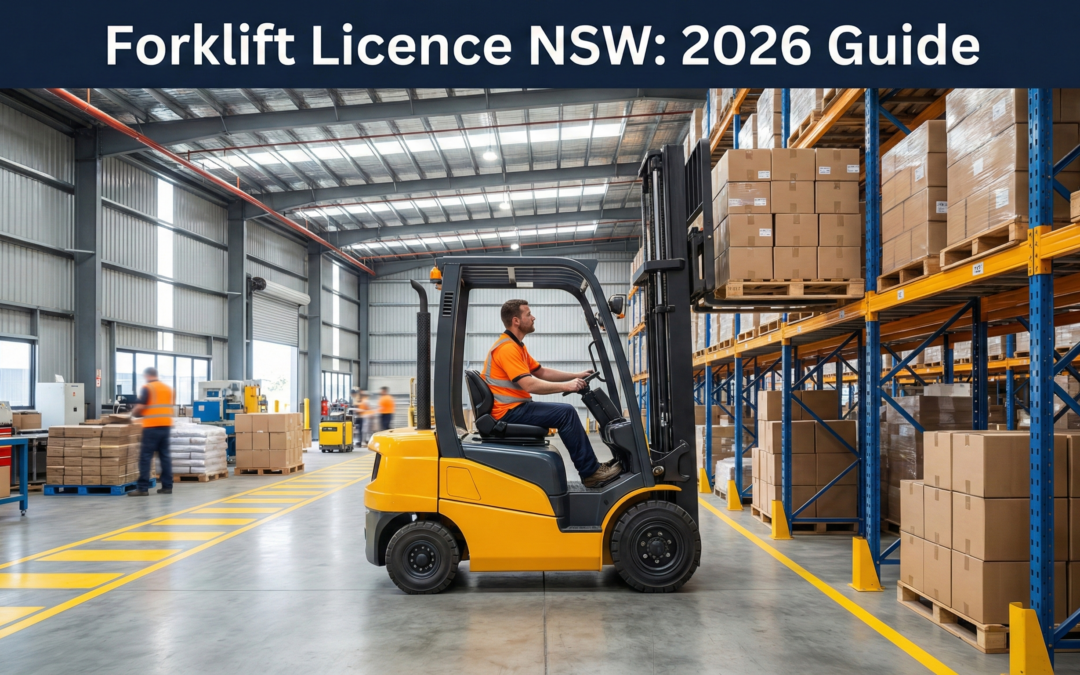
Forklift Licence | Your 2026 Guide to Getting Hired in the Illawarra

Forklift Licence | Your 2026 Guide to Getting Hired in the Illawarra

If you walk into any warehouse, distribution centre, or construction yard in the Illawarra, and Greater Sydney Regions you will see them. They are the heartbeat of the supply chain, moving tonnes of material every hour, keeping the economy flowing. We are talking, of course, about Forklift Operators.

As we head deeper into 2026, the demand for qualified logistics staff in NSW is hitting new highs. With the explosion of e-commerce and the expansion of industrial hubs in the Unanderra, Kembla Grange, Southern and Western Sydney corridor, the “Forklift Ticket” has become one of the most valuable pieces of plastic you can have in your wallet.

But here is the reality check: operating a forklift isn’t like driving a go-kart. It is classified as High Risk Work for a reason. A fully loaded counterbalance forklift weighs as much as three family cars and steers from the rear. If you get it wrong, you don’t just dent a bumper; you can bring down racking or crush a co-worker.

In this guide, we are going to break down exactly how to get your Forklift Licence (LF) in NSW, the difference between the tickets, and why quality training is the difference between getting hired and getting walked off-site.

The “LF” Ticket: What Actually Is It?

First, let’s clear up the jargon. In Australia, a forklift licence is officially known as a National High Risk Work Licence (HRWL), Class LF.

  • L stands for Load-shifting.

  • F stands for Forklift.

This licence permits you to operate a forklift truck equipped with a mast and an elevating load carriage. This covers almost every standard forklift you will see on a construction site or in a warehouse, including:

  • Counterbalance forklifts (gas, diesel, or electric).

  • Reach trucks (common in high-density warehousing).

  • Rough terrain forklifts (often used on building sites).

Important Note: This does not cover an “Order Picker” (LO). That is a completely different licence for machines where the operator rises into the air with the load. If you want to work in a high-tech distribution centre, you might eventually need both, but the LF is the industry standard starting point.

Why Do You Need a Licence? (Can’t I Just Learn on the Job?)

In the “old days,” you might have learned by hopping on a machine in the back paddock. Those days are gone.

Under SafeWork NSW legislation, you must hold a current High Risk Work Licence (HRWL) to operate a forklift in any workplace. Operating without one carries massive fines for both you and your employer. More importantly, if an accident occurs and the operator is unlicensed, insurance companies will walk away, leaving the business (and potentially the operator) liable for millions in damages.

This is why employers in 2026 are so strict. They won’t even look at your resume unless they see “Current HRWL – Class LF” listed at the top.

The 2-Day Course: What to Expect at AOTA

At All Onsite Training and Assessment (AOTA), we run a streamlined but rigorous 2-day Forklift Course. We designed this timeline to balance the need for thorough safety training with the reality that our students want to get qualified and get back to work quickly.

Here is the breakdown of the two days:

Day 1: Theory & Calculations (The Classroom)

Before you touch the key, you need to understand the machine. Forklifts are unique vehicles with a “stability triangle.”

  • The Physics: You will learn why forklifts tip over (it’s usually cornering too fast or turning with a raised load).

  • The Maths: Yes, there is a little bit of maths. You need to look at a data plate (load chart) and calculate if the forklift can safely lift a specific weight at a specific height and load centre distance.
    The Maths aspect mentioned in the article (Load Charts).

  • Video Analysis: We review real-world incidents to show you exactly what happens when safety protocols are ignored.

Practical Training (The Seat Time)

This is where you develop your “muscle memory.” You will spend the day in our dedicated training facility in Unanderra, operating real machines.

  • Pre-Start Checks: Every shift starts with a check. You’ll learn to inspect tyres, hydraulics, fluids, and safety guards.

  • Maneuvering: You will practice navigating tight chicane courses (forward and reverse) without touching the cones.

  • The Lifts: You will practice lifting loads from different heights, stacking pallets, and placing loads into racking systems.

  • High & Low: We train you on different sized loads so you get a feel for how the machine’s balance changes.

Day 2: The Assessment

This is the day that counts. A SafeWork NSW accredited assessor will put you through the paces.

  1. Knowledge Test: A written assessment covering the theory from Day 1.
  2. Calculations Test: Proving you can read a load chart accurately.
  3. Performance Assessment: You will be given a specific task to complete in the forklift (e.g., “Move those three pallets from the racking to the truck loading zone”). You must complete this safely, following all procedures, to pass.

The “Cowboy” Factor: Why Cheap Courses Are a Trap

You might see ads online for “1-Day Forklift Tickets.” Be very careful.

Unless you have significant prior experience and just need to re-sit a licence, it is almost impossible for a beginner to learn the skills required to be safe in one day.

These “Tick and Flick” courses might get you the piece of paper, but they won’t get you the job. Why? Because the first thing a warehouse manager will do is give you a VOC (Verification of Competency). They will watch you drive for 5 minutes.

  • If you turn with your tynes too high…

  • If you forget to look over your shoulders before reversing…

  • If you scrape the racking…

You will be asked to leave immediately. The cheap course ends up costing you a career. At AOTA, we pride ourselves on producing operators who are “site-ready,” not just “test-ready.”

The Career Outlook in the Illawarra, Southern and Western Sydney

These areas are transforming. We are seeing a shift from pure heavy manufacturing to a diverse mix of logistics, construction, and green energy. All of these sectors need forklifts.

  • Warehousing: The rise of online shopping means more distribution centres in the greater Sydney and Illawarra regions

  • Retail: Every Bunnings, Woolworths, and major retailer needs ticketed staff.

  • Construction: With the housing and infrastructure boom, telehandlers and rough-terrain forklifts are working overtime.

Pay Rates: Entry-level forklift roles often start above the minimum award, but experienced operators who can handle high-reach machines or work in specialised environments (like cold storage or hazardous goods) can command significantly higher wages.

Ready to Get Started?

You don’t need a degree to earn a good living, but you do need the right ticket. A Forklift Licence is the most versatile qualification in the Australian industrial sector. It is the “Swiss Army Knife” of resumes—it’s always useful.

Prerequisites to Enrol:

  • Must be 18 years or older.

  • Must have 100 points of ID.

  • Must have basic English language skills (verbal and written).

Next Course Dates: We run Forklift courses every week at our Unanderra facility. Because the classes are capped to ensure everyone gets enough driving time, they book out quickly.

[Click Here to Check the Training Schedule and Book Your Spot]

Don’t wait for the job ad to appear before you get the licence. By then, it’s too late. Get qualified now, so when the opportunity knocks, you are ready to answer.

Ready to unlock your full potential? Explore our courses further to discover the perfect training path for you. Or, if you have any questions or need personalised guidance, don’t hesitate to contact us. Our friendly team is here to support you every step of the way.

Remember, your dream career is within reach. With AOTA by your side, you can build the skills, confidence, and qualifications you need to succeed. So, take the first step today and start building your future!

Dedicated to your success

Nigel

Know the Risk | Interactive Hazard Finder

From high-risk zones to hidden hazards, this interactive tool helps you identify worksite dangers and shows you the safety training to tackle them confidently.
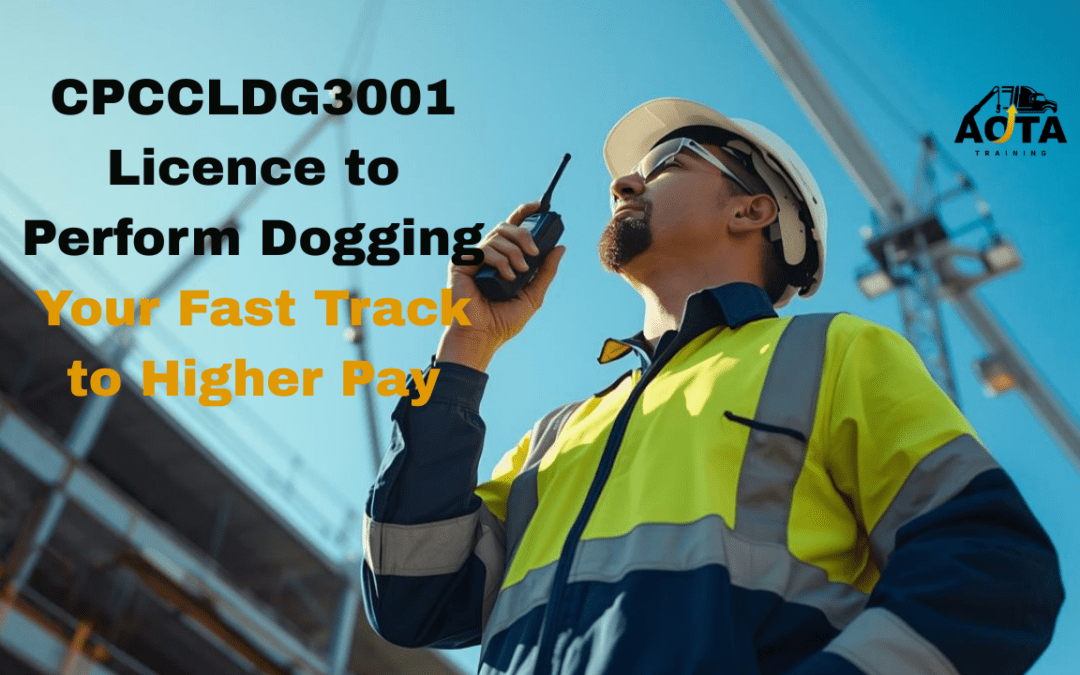
How to Get Your CPCCLDG3001: Licence to Perform Dogging in NSW in 2026

How to Get Your CPCCLDG3001: Licence to Perform Dogging in NSW in 2026

The Ultimate Guide to Getting Your Dogman Ticket in NSW (2026 Edition)

If you have spent any time on a construction site in the Illawarra lately, you know the story. The crane is swinging, the site is buzzing, and the person with the whistle and the radio is calling the shots. That person is the Dogman. And right now, in 2026, they are one of the most in-demand professionals in NSW.

With massive infrastructure projects kicking off—from the BlueScope land transformation to the Renewable Energy Zone (REZ)—recruiters are scrambling for qualified operators. But they aren’t just looking for bodies; they are looking for ticketed professionals who know what they are doing.

If you are currently laboring for $30 an hour and looking at the guys in the high-vis vests earning $50+ an hour, this guide is for you. We are going to break down exactly how to get your Dogman Ticket (officially known as the CPCCLDG3001 Licence to Perform Dogging), what the course involves, and how to make sure you don’t just pass the test, but actually get the job.

“Ticket” vs. “Licence”: What’s the Difference?

Before we dive into the training, let’s clear up the confusion that floods our inbox every week.

  • “I need my Dogman ticket.”

  • “Do you do the Dogging licence?”

  • “Is the High Risk Work card the same thing?”

The short answer: Yes, they are all the same thing.

In the industry, everyone calls it a “Ticket.” On the paperwork and SafeWork NSW legislation, it’s called a “High Risk Work Licence (HRWL).”

When you complete your training with a Registered Training Organisation (RTO) like AOTA, you aren’t just getting a piece of paper; you are applying for a nationally recognised licence issued by SafeWork NSW. This licence is valid for 5 years and allows you to work on any site in Australia.

Why the “Dogman” is the Most Critical Job on Site

A lot of people think the crane operator is the boss of the lift. They’re wrong. The crane operator is often working blind, relying 100% on the eyes, ears, and judgment of the Dogman.

The technical side (slinging)

If the Dogman miscalculates the weight of a steel beam, picks the wrong sling, or gives a confusing radio signal, people die. It is that simple. That is why this is classified as “High Risk Work.”

However, with that responsibility comes the reward. Because the safety of the site rests on your shoulders, the pay rates reflect it. In the Illawarra region, entry-level Dogmen can expect significantly higher wages than general laborers, with experienced operators commanding premium rates, especially on union sites or night shifts.

The Prerequisites: Can Anyone Do It?

You don’t need a university degree or a background in engineering to be a great Dogman. In fact, some of the best operators we’ve trained were former chefs, truck drivers, or general laborers.

To enrol in the course, you only need three things:

  1. Age: You must be 18 years or older.
  2. Language: You must have a basic command of the English language (SafeWork NSW requires you to complete the assessment in English).
  3. ID: You need 100 points of ID (e.g., Passport, Driver’s Licence, Medicare Card).

Note: You do NOT need your White Card to do the course, but you WILL need it to step onto a construction site to work.

The 5-Day Course Breakdown: What Actually Happens?

At AOTA, we don’t believe in “Tick and Flick” courses. We run a comprehensive 5-day program at our Unanderra facility designed to take you from “green” to “site-ready.”

Here is what your week will look like:

Days 1-2: The Theory & The Maths (Don’t Panic!)

The first two days are classroom-based. This is where we cover the “Plan Work” component.

  • The Maths: This is the part that scares most people. You will learn to calculate the Working Load Limit (WLL) of flexible steel wire rope, chains, and synthetic slings.

  • The Myths: You don’t need to be a math genius. If you can use a calculator (which we provide) and follow a formula, you will be fine. Our trainers are experts at breaking this down simply.

  • Safety: Understanding the hierarchy of control, hazard identification, and how to read a load chart.

Days 3-4: The Practical (Getting Hands-On)

This is where the fun starts. You get out of the classroom and into the yard.

  • Slinging Loads: You will get hands-on with chains, tags, shackles, and snatch blocks. You’ll learn how to inspect gear for defects—a skill that will save your life one day.

  • Directing the Crane: We put you on the radio. You will practice guiding a slewing mobile crane operator to move loads through obstacles, landing them precisely on targets. You’ll learn the standard whistle signals and hand signals that are the universal language of Australian construction sites.

  • The “Simulation”: Unlike other schools that might use a dummy load in a warehouse, we simulate real site conditions. You’ll deal with wind, obstacles, and the pressure of efficient communication.

Day 5: The Assessment

The final day is assessment day. SafeWork NSW requires you to pass three components:

  1. Knowledge Assessment: A written or verbal test covering the theory.
  2. Calculations Assessment: Proving you can do the maths to lift safely.
  3. Performance Assessment: A practical test where you sling a load and guide a crane through a complex task while an assessor watches.

The “Experience Catch-22” (And How to Beat It)

We hear it all the time: “I’ve got my ticket, but no one will give me a start because I don’t have experience.”

This is the biggest hurdle in the industry. Employers are terrified of hiring “green” operators who might damage a $500,000 load or injure a worker.

This is the AOTA difference. Because our training is known for being rigorous and realistic, employers in the Illawarra trust the AOTA brand. When you finish our course, you haven’t just sat in a room; you’ve sweated in the yard.

Pro Tip for Getting Hired: Don’t just email your resume. Walk onto site or into the labour hire office. Show them your shiny new HRWL card and say: “I trained at AOTA. I know my load charts, I know my knots, and I’m ready to do a VOC (Verification of Competency) right now.” Confidence sells.

Beyond the Dogman Ticket: The Career Pathway

Getting your Dogging ticket is just the first step. It is the “Gateway Ticket” that opens the door to the rest of the High Risk Work industry.

Once you have your Dogman (DG) ticket, you can progress to:

Ready to Upgrade Your Paycheck?

2026 is moving fast. The projects are approved, the cranes are going up, and the recruiters are hiring. Don’t sit on the sidelines watching the action.

Next Course Dates: We run Dogging courses regularly at our Unanderra facility. Spaces fill up fast (usually 2-3 weeks in advance).

[Click here to view the Training Schedule and Secure Your Spot]

Don’t wait for the “perfect time.” The best time to get ticketed was yesterday. The second best time is today.

Ready to unlock your full potential? Explore our course library further to discover the perfect training path for you. Or, if you have any questions or need personalised guidance, don’t hesitate to contact us. Our friendly team is here to support you every step of the way.

Remember, your dream career is within reach. With AOTA by your side, you can build the skills, confidence, and qualifications you need to succeed. So, take the first step today and start building your future!

Dedicated to your success

Nigel

Know the Risk | Interactive Hazard Finder

From high-risk zones to hidden hazards, this interactive tool helps you identify worksite dangers and shows you the safety training to tackle them confidently.

Boost Your Construction Salary | Why Paying for Your Own Ticket Pays Off in 2026

Boost Your Construction Salary | Why Paying for Your Own Ticket Pays Off in 2026

Stop Waiting for Your Boss to Pay | Why a $1,500 Investment is Worth $60/hr in 2026

How many times have you heard this one?

“Stick with us, mate. We’ll put you through the course next quarter.” “We’re just waiting for the new budget, then we’ll get you that Dogging ticket.” “We can’t spare you off-site right now. Maybe next month.”

Six months later, you’re still on the same rate, doing the same grunt work, while the boss is still “looking into it.”

It’s the “Boss Won’t Pay” Standoff. You feel stung. You think, “Why should I pay $1,500 out of my own pocket when the company gets the benefit of my skills?”

It’s a fair question. But while you are standing on principle, waiting for someone else to foot the bill, you are losing money. Serious money.

The Brutal Math of Waiting

Let’s stop talking about “fairness” and start talking about Return on Investment (ROI).

Right now, as a general labourer or trade assistant in the Illawarra, you are likely capped at $30–$35 an hour. You’re working hard, but the financial ceiling is low and heavy.

Now, look at the guys on the big infrastructure projects—the ones holding their High Risk Work (HRW) licenses.

  • Dogging (DG)

  • Basic to Intermediate Rigging (RB/RI)

  • Crane Operators (CN)

On major sites like the upcoming Port Kembla Steelworks Transformation or the Illawarra Renewable Energy Zone, these roles don’t pay labourer rates. Once you factor in site allowances, height penalties, and overtime, these operators are commanding $50, $60, or even $70+ an hour.

Let’s be conservative and say a ticket gets you just a $15/hour bump.

  • That’s $570 extra per week (on a standard 38-hour week).

  • That’s roughly $2,200 extra per month.

  • That’s over $27,000 extra per year.

The average High Risk Work course costs between $1,000 and $1,500.

If you pay for it yourself, you make that money back in your first three weeks of work at the higher rate.

Every month you wait for your boss to “find the budget,” you are effectively lighting $2,000 on fire. You are paying for the course anyway—in lost wages.

Ownership = Freedom (The “Golden Handcuffs” Trap)

There is another hidden cost to letting your boss pay: Leverage.

When the company pays for your ticket, there are strings attached. They often make you sign a bonding contract: “You have to stay for 12 months, or you pay us back.”

They own that ticket. And in a way, they own you.

You can’t leave for a better offer because you’re tied down. You can’t demand a raise because you “owe” them.

When you pay for it yourself, you own the ticket. It goes in your wallet. It is 100% portable.

  • If a better opportunity comes up at the No. 6 Blast Furnace Reline, you can take it.

  • If a FIFO position pops up offering big money, you don’t have to ask for permission.

  • You can hand in your notice and walk.

Having your own tickets gives you the power to say “no” to bad conditions and “yes” to the highest bidder.

The 2026 “Illawarra Gold Rush” is Coming

We are about to see a massive shift in the local job market.

The BlueScope Port Kembla Land Transformation is a multi-billion dollar project. The region is gearing up for heavy industrial upgrades that will last for years. 

These projects are not looking for general hands to sweep floors. They need operators. They need people who can:

  • Sling a complex load (Dogging).

  • Erect steel structures (Rigging).

  • Work safely at heights (EWP/Scaffolding).

If you are waiting for a local employer to prep you for these jobs, you will be waiting forever. They know that as soon as you get that ticket, you become valuable to everyone else. They have zero incentive to train you.

Bet on Yourself for 2026

The Illawarra market is tightening. In 2026, the gap between “unskilled labour” and “ticketed operators” is going to get wider. The labourers will be fighting for scraps, while the multi-skilled operators will be naming their price.

Don’t let a $1,500 course fee stand between you and a $120,000 year.

Stop waiting for permission. Get the ticket, get the raise, and take control of your career.

Book your spot at AOTA today. We run regular courses in Unanderra for Dogging, Rigging, and Scaffolding. We’ll get you skilled up and site-ready while everyone else is still waiting for their boss to call back.

Ready to unlock your full potential? Explore our high risk courses further to discover the perfect training path for you. Or, if you have any questions or need personalised guidance, don’t hesitate to contact us. Our friendly team is here to support you every step of the way.

Remember, your dream career is within reach. With AOTA by your side, you can build the skills, confidence, and qualifications you need to succeed. So, take the first step today and start building your future!

Dedicated to your success

Nigel

Know the Risk | Interactive Hazard Finder

From high-risk zones to hidden hazards, this interactive tool helps you identify worksite dangers and shows you the safety training to tackle them confidently.
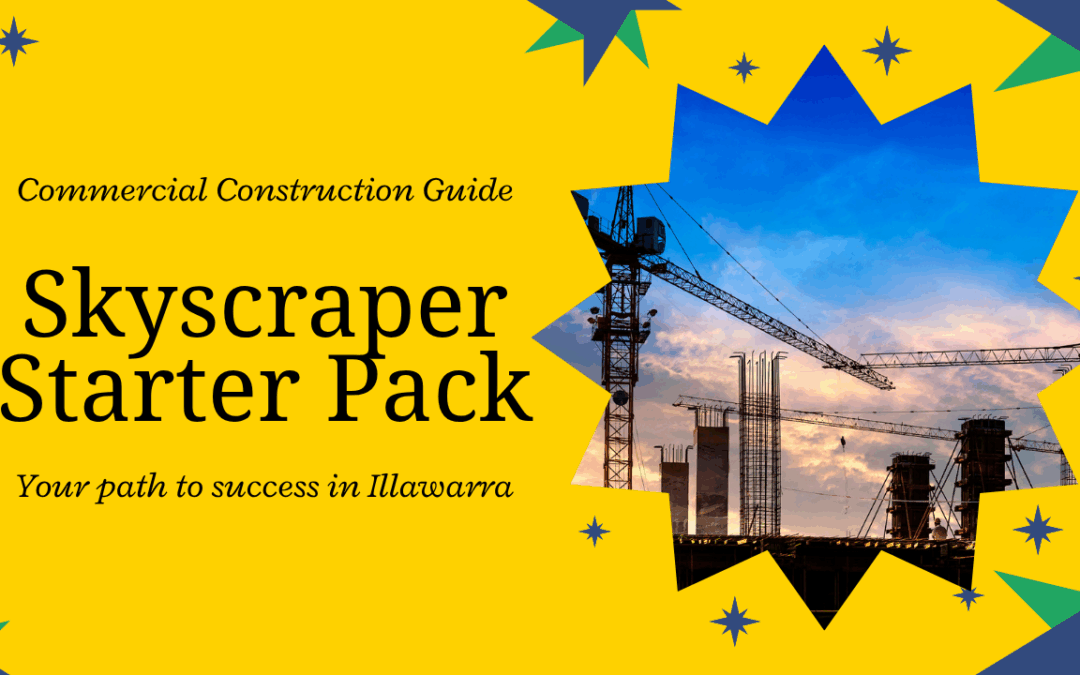
From the Ground Up | Essential Licences for High-Rise Construction Jobs in the Illawarra

From the Ground Up | Essential Licences for High-Rise Construction Jobs in the Illawarra

Look up. Across Wollongong, Shellharbour, and down to the Shoalhaven, you’ll see them: the towering skeletons of cranes, the steady rise of new floors, the buzz of activity that signals growth. These aren’t just buildings; they’re vertical cities of opportunity. Projects like the massive Shoalhaven Hospital Redevelopment and the state-of-the-art UOW-Dragons Centre are more than just concrete and steel—they are complex, multi-year operations that require hundreds of skilled, qualified workers.  

But how do you go from being the person on the street looking up, to the person on-site building up? It’s not about luck; it’s about having the right skills and, crucially, the right tickets. This isn’t just about ticking boxes. The Australian construction industry is facing a productivity challenge costing the economy billions annually. A huge part of solving that is having a workforce that is not just present, but proficient, safe, and certified.   

This guide is your roadmap. We’re going to break down what really happens on a major commercial building site in the Illawarra and show you the exact training you need to get your foot in the door and build a real career.

Phase 1 | The Ground Game – Setting the Stage

Before a single steel beam is lifted, a massive amount of work happens at ground level. This is the foundation, both literally and for your career. Getting this stage right is everything.

 Your Key to the Gate | The Construction White Card

Let’s be crystal clear: without this, you’re not getting past the front gate. The Construction White Card (CPCCWHS1001 Prepare to work safely in the construction industry) is the absolute, non-negotiable first step. It’s not just a formality; it’s a foundational course that covers essential safety principles, how to identify hazards, and what to do in an emergency. Think of it as your passport to every single construction site in Australia.

 The Earthmovers | Shaping the Site

Once the surveyors have marked out the site, the big machines roll in. This isn’t just about digging a hole; it’s a precise operation.

  • What you’ll see: Excavators performing bulk earthworks, loaders moving soil and materials, and smaller skid steers handling the detailed work around foundations and services.
  • What you’ll need: This is where your plant operation skills become your ticket to consistent work. Holding a qualification for Excavator Operations, Skid Steer Operations, and Front End Loader Operations makes you incredibly versatile during this busy initial phase.

Going Vertical | The World of High-Risk Work

This is where the skyline starts to change. The second a load is lifted by a crane, or a worker steps onto a boom lift, the site enters the realm of High-Risk Work. These activities are so potentially dangerous that they are governed by strict laws, and you must hold a specific High-Risk Work Licence (HRWL) to perform them. This is where you can build a specialised, in-demand career.

The Crane’s Choreographer | Dogging & Rigging

Most people see the crane operator, but they often miss the most critical person on the ground: the dogger or rigger. They are the brains of the lifting operation.

  • What’s the difference? A Dogger is the crane’s eyes and ears. They are responsible for assessing the load, choosing the correct slinging technique, and directing the crane operator with hand signals or radio commands. A Rigger does everything a dogger does, but they are also qualified to handle more complex tasks, like erecting and dismantling cranes and scaffolding, working with tilt-up panels, and performing dual crane lifts.
  • The Pathway: You start with a Dogging (DG) licence. From there, you can progress to Basic Rigging (RB), Intermediate Rigging (RI), and Advanced Rigging (RA), with each ticket opening up more complex and higher-paying work.
  • Why it’s critical: With around 60% of crane incidents in Australia attributed to human error, the skill of the person slinging the load is paramount. This isn’t a job you can learn by watching; it requires formal, assessed training.  

Reaching for the Sky | EWPs and Height Safety

As the building grows, so does the need to work safely off the ground.

  • Working at Heights: This ticket is essential for almost everyone on a multi-story site, from steel erectors to plumbers and electricians. It teaches you how to use fall arrest systems like harnesses and anchor points correctly.
  • Elevating Work Platforms (EWP): For operating a boom-type EWP where the boom can extend 11 metres or more, you need a specific High-Risk Work Licence (WP). This is one of the most in-demand tickets on commercial sites. Don’t confuse this with the Yellow Card for operating scissor lifts or smaller platforms under 11 metres!

The Final Stretch | Enclosing and Fitting Out

With the structure up, the focus shifts to making it a functional building. This involves installing facades, windows, internal walls, and all the essential services.

  • What you’ll see: Teams working on the building exterior from EWPs, and inside in service risers, ceiling spaces, and plant rooms.
  • What you’ll need: Your Working at Heights ticket remains essential. This is also where Confined Space Training becomes critical. A service duct, a lift well, or a water tank might not look like a confined space, but they are, and they pose invisible risks like atmospheric hazards. Having this qualification makes you a valuable asset during the fit-out phase.

The Safety Net | Skills for Every Single Person on Site

Some skills aren’t tied to a specific phase; they’re about the human element of keeping a site safe.

When Seconds Count, First Aid

On a busy site, accidents—from minor cuts to serious injuries—can and do happen. Being the person who can confidently step in and administer first aid while waiting for paramedics is an invaluable skill. A Provide First Aid certificate makes you a designated first aid officer, a role every work crew needs.

The Hazard You Can’t See, Mental Health

This is the topic most blogs won’t touch, but it’s the most important. The statistics are sobering: Australian construction workers are six times more likely to die by suicide than from a workplace accident. The pressures of the job are immense.  

  • What it is: Mental Health First Aid training doesn’t teach you to be a therapist. It teaches you to be a supportive colleague. It gives you the skills to notice when a mate is struggling, the confidence to ask “Are you okay?”, and the knowledge to guide them towards professional help.  
  • Why it matters: In an industry that is losing too many good people, being a trained Mental Health First Aider makes you a leader in creating a safer, more supportive site culture.

Building a career in commercial construction is a step-by-step process. It starts with a White Card and builds from there with the specific plant, high-risk, and safety qualifications that match your goals.

References:

  • Shoalhaven Hospital Redevelopment Project Update, May 2025.  
  • UOW-Dragons Community and High Performance Centre Construction Announcement, March 2025.  
  • Australian Constructors Association, ‘Nailing Construction Productivity’ Report.  
  • MATES in Construction, Mental Health Awareness Statistics.  
  • All Onsite Training and Assessment, Mental Health First Aid Course Information.  

Ready to unlock your full potential? Explore our website further to discover the perfect training path for you. Or, if you have any questions or need personalised guidance, don’t hesitate to contact us. Our friendly team is here to support you every step of the way.

Remember, your dream career is within reach. With AOTA by your side, you can build the skills, confidence, and qualifications you need to succeed. So, take the first step today and start building your future!

Dedicated to your success

Nigel

Know the Risk | Interactive Hazard Finder

From high-risk zones to hidden hazards, this interactive tool helps you identify worksite dangers and shows you the safety training to tackle them confidently.

Understanding RB RI and RA Type Rigging Courses

Understanding RB RI and RA Type Rigging Courses

Imagine standing at the foot of a towering construction site. Cranes are lifting massive steel beams into place, workers are strategically positioned across the structure, and in the middle of it all is the rigging team, ensuring that every lift is safe and precise. Behind every successful lift is a rigger with the right qualifications and training.

In Australia’s booming construction industry, riggers are critical to the safe and efficient movement of loads. But not all riggers are trained equally—there are various levels of rigging certifications that determine what kind of work you’re qualified to handle. These levels are known as Basic Rigging (RB), Intermediate Rigging (RI), and Advanced Rigging (RA). Understanding the differences between these certifications is key to navigating your career path in this exciting field.

With infrastructure spending projected to exceed $290 billion by 2025, there’s never been a better time to pursue a rigging certification and expand your career opportunities. In this article, we’ll break down the three levels of rigging courses and explain how each can help you advance in the construction and heavy industries.


What Are RB, RI, and RA Rigging Certifications?

The Three Tiers of Rigging Certifications

In Australia, rigging certifications are divided into three levels based on the complexity of the tasks and the equipment involved. Here’s a look at each level:

1. Basic Rigging (RB)
The Basic Rigging (RB) certification is the entry-level qualification for those looking to become a rigger. With an RB licence, you’ll be able to perform basic rigging tasks, such as:

  • Erecting structural steel.
  • Setting up hoists, static lines, and safety nets.
  • Installing pre-cast concrete panels.

This qualification allows you to work on a range of construction sites, but it’s primarily focused on lower-risk rigging tasks. Basic rigging is ideal for those starting in the industry or looking to build foundational skills.

2. Intermediate Rigging (RI)
The Intermediate Rigging (RI) certification is the next step up and builds on the skills learned in basic rigging. With an RI licence, you’ll be qualified to perform more complex rigging tasks, including:

  • Rigging cranes and other lifting devices.
  • Erecting tilt-up panels.
  • Performing rigging tasks involving the use of powered hoists.

Intermediate rigging opens the door to more challenging roles in construction and heavy industries, where more precise and technical rigging skills are required.

3. Advanced Rigging (RA)
The Advanced Rigging (RA) certification is the highest level of rigging qualification in Australia. With an RA licence, you’ll be able to handle the most complex rigging jobs, such as:

  • Erecting tower cranes.
  • Rigging for large-scale demolition projects.
  • Performing dual-lift operations.

Advanced rigging jobs are often found in large infrastructure projects and heavy industries like mining and offshore oil rigs. This certification qualifies you to take on supervisory roles, as well as high-risk projects that require advanced technical knowledge.


Prerequisites for Each Certification

What You Need Before You Enrol

Each level of rigging certification has specific prerequisites to ensure that you have the necessary skills and experience before progressing.

Basic Rigging (RB) Prerequisites
To enroll in a Basic Rigging course, you need to:

  • Hold a valid Dogging (DG) licence. The dogging licence covers essential skills in directing crane movements and securing loads, which are foundational for rigging work.
  • Be at least 18 years old.

This is an entry-level certification, so no prior rigging experience is necessary beyond the dogging qualification.

Intermediate Rigging (RI) Prerequisites
To take the Intermediate Rigging course, you must:

  • Have completed the Basic Rigging (RB) certification.
  • Hold a valid Dogging (DG) licence.

This ensures that you’ve already gained some rigging experience and are ready to take on more complex tasks.

Advanced Rigging (RA) Prerequisites
For Advanced Rigging, you need to:

  • Hold both the Basic (RB) and Intermediate (RI) Rigging licences.
  • Have experience working as an intermediate rigger.

Advanced rigging requires a thorough understanding of complex lifting and rigging operations, so the course builds on the skills learned in the previous two levels.


Career Pathways Based on Rigging Certification

How Each Rigging Certification Impacts Your Career

The level of rigging certification you hold determines the types of projects you can work on and the level of responsibility you’ll take on in the workplace. Here’s how each certification can shape your career:

Basic Rigging (RB) Career Opportunities
With a Basic Rigging licence, you’ll primarily work on smaller-scale construction projects. You’ll be responsible for setting up scaffolding, hoists, and other equipment to support construction activities. Common roles for basic riggers include:

  • Construction Site Rigger: Setting up rigging systems for general construction tasks.
  • Precast Concrete Installer: Installing pre-cast panels and ensuring their safe placement.

While basic rigging is essential work, career advancement typically requires moving on to higher-level certifications.

Intermediate Rigging (RI) Career Opportunities
An Intermediate Rigging licence opens the door to more technical and higher-paying roles. With this certification, you can work on larger construction projects, often involving more specialized rigging equipment like cranes and hoists. Career paths for intermediate riggers include:

  • Crane Rigger: Setting up and operating cranes for large-scale construction or demolition.
  • Tower Erector: Rigging for the construction of communication towers or high-rise buildings.

Intermediate rigging offers a significant step up in both responsibility and earning potential, with many projects requiring the precision that comes with more advanced training.

Advanced Rigging (RA) Career Opportunities
With an Advanced Rigging licence, you’re qualified for the most challenging and high-risk rigging roles. You’ll often work on major infrastructure projects, where safety and precision are paramount. Career opportunities at this level include:

  • Rigger Supervisor: Overseeing rigging operations and managing teams of riggers on large construction or mining projects.
  • Demolition Rigger: Handling complex rigging tasks during the controlled demolition of structures.
  • Offshore Rigger: Working on oil rigs, where heavy and complex equipment must be moved safely and efficiently.

Advanced riggers are in high demand, particularly for projects like major urban developments and mining operations in Australia’s resource-rich regions.


Choosing the Right Rigging Course for Your Career

How to Decide Which Certification Is Right for You

If you’re just starting out in the rigging industry, the Basic Rigging (RB) course is the perfect entry point. It provides a solid foundation of skills that will open up a range of opportunities on construction sites. Once you’ve gained some experience, progressing to Intermediate Rigging (RI) can help you take on more specialized roles, such as crane operation.

For those who are committed to a long-term career in rigging and want to pursue leadership positions or work on the most technically demanding projects, the Advanced Rigging (RA) certification is the ultimate goal. It offers the most diverse range of career opportunities and the potential for higher salaries.


Elevate Your Career with the Right Rigging Certification

Rigging is a highly specialized and essential role in Australia’s construction and heavy industries. Whether you’re just starting out with a Basic Rigging licence or aiming to advance your career with Intermediate or Advanced certifications, each level provides valuable skills and opens up new job opportunities.

With Australia’s infrastructure projects on the rise, now is the perfect time to invest in your rigging qualifications. By choosing the right certification for your career goals, you’ll position yourself as a valuable asset in a growing industry.

Ready to get started? Explore rigging courses today and take the first step towards mastering the art of rigging.


References:

  1. Infrastructure Australia, “National Infrastructure Plan 2025,” 2024.
  2. Safe Work Australia, “High-Risk Work Licences,” 2023.
  3. National Heavy Vehicle Regulator (NHVR), “Rigging and Lifting Guidelines,” 2024.


Ready to unlock your full potential? Explore our website further to discover the perfect training path for you. Or, if you have any questions or need personalised guidance, don’t hesitate to contact us. Our friendly team is here to support you every step of the way.

Remember, your dream career is within reach. With AOTA by your side, you can build the skills, confidence, and qualifications you need to succeed. So, take the first step today and start building your future!

Dedicated to your success

Nigel

Illawarra Project | Interactive Skillset Finder

Major projects are shaping our region, this interactive tool helps you identify project skillsets required and the courses available to tackle them confidently.