



HR vs. HC Licence | Which Heavy Vehicle Ticket is Right for You?
It’s a rainy Tuesday morning at a loading dock in Unanderra. You’re sitting in the cab of your 10-tonne rigid, waiting for the forklift driver to finish his coffee. You watch a B-Double roll in—effortlessly reversing a 26-metre combination into a tight finger dock like he’s parking a Mini Cooper.
You know that driver is earning significantly more than you. You know he’s probably not hand-unloading 500 cartons of stock when he gets to the other end. And you know there’s a shortage of drivers just like him.
So, why are you still stuck in the rigid?
For many drivers, the jump from Heavy Rigid (HR) to Heavy Combination (HC) feels like a massive leap. It’s not just the size of the truck; it’s the articulation, the gearbox anxiety, and the cost of the course.
But with the Australian transport industry facing a critical shortage of 26,000 drivers right now—projected to hit 78,000 by 2029—there has never been a better time to upgrade.
If you are sitting on the fence, this guide is for you. We’re going to break down the real differences between HR and HC, not just in terms of axles and GVM, but in terms of lifestyle, bank balance, and career longevity.
The Heavy Rigid (HR): The “Backbone” of the Industry
Let’s start with the Heavy Rigid. If the transport industry is a human body, HR drivers are the muscles. They do the heavy lifting in our cities and suburbs.
What is it?
A Heavy Rigid vehicle is defined as a truck with 3 or more axles and a Gross Vehicle Mass (GVM) greater than 8 tonnes. Importantly, it is a rigid vehicle—meaning the cab and the trailer are fixed on a single chassis. It doesn’t bend.
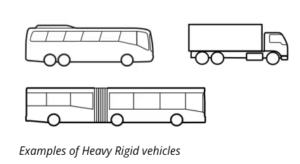
The Typical Roles
If you hold an HR licence in the Illawarra or Sydney, you are likely looking at roles like:
-
Waste Management: Driving side-loaders or rear-loaders for council contracts.
-
Construction Agitators: Delivering concrete to sites (the classic “agitator driver” role).
-
Local Distribution: Delivering palletised goods to supermarkets and retail stores.
-
Removalists: Driving the big Pantechs for house moves.
The Salary Reality (2026)
According to the latest 2026 data, the average salary for an HR driver in Australia hovers between $65,000 and $85,000 per year.
It is solid, reliable money. But there is a ceiling. Because HR work is often “local,” you miss out on the lucrative kilometre rates and “living away from home” allowances that boost a truckie’s pay packet. You are trading salary for the convenience of sleeping in your own bed every night.
The Heavy Combination (HC): The “Career Builder”
This is where the game changes. An HC licence allows you to drive a prime mover attached to a semi-trailer with a GVM of more than 9 tonnes.
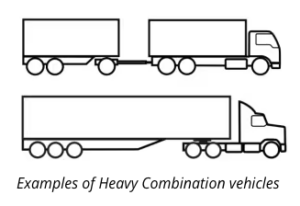
The “Bend” Factor
The defining feature of the HC is articulation. The vehicle pivots behind the cab. This introduces a layer of complexity that scares many drivers off, but it’s also what makes the licence so valuable.
When you drive an HC, you aren’t just steering; you are managing a “sweep path.” You need to know where your trailer wheels are at all times because they aren’t following the same track as your steer tyres.
The Salary Jump
Here is the stat that matters: The average salary for HC and Interstate drivers sits in the $110,000 to $135,000 bracket.
That is a potential $40,000 per year pay rise just for adding a pivot point to your licence.
Why the gap?
- Skill Barrier: Fewer people can reverse a semi-trailer than a rigid. Scarcity drives up wages.
- Distance: HC roles often involve line-haul work (Sydney to Melbourne, or Illawarra to Brisbane), which attracts higher km rates.
- Dangerous Goods: Many fuel tankers and chemical transport rigs are HC vehicles. If you add a DG (Dangerous Goods) ticket to your HC licence, you are entering the top tier of driver earnings.
The “Gearbox” Dilemma: Condition B vs. Road Ranger
This is the section most blogs gloss over, but it is the most critical decision you will make when booking your course.
In 2026, you can get your licence in an Automatic, but should you?
1. Automatic / Synchromesh (Condition B)
If you pass your test in an automatic or a synchromesh manual (like a car gearbox), your licence will be marked with a “Condition B” restriction.
-
Pros: It’s easier and faster to learn. You can often get licenced in 1-2 days.
-
Cons: You are legally forbidden from driving a Non-Synchromesh (Crash Box) vehicle.
2. The Road Ranger (Unrestricted)
The Eaton Fuller “Road Ranger” is a non-synchromesh gearbox. It requires you to double-clutch and match the engine revs (RPM) to the road speed (gear) to change gears. There is no synchro ring to help you slide it in.
-
Pros: If you pass in this, you get an Unrestricted Licence. You can drive anything—manual, auto, or crash box.
-
Cons: It takes longer to master. You will grind gears. You will get frustrated.
Why the “Crash Box” Still Matters in 2026
You might hear people say, “All new trucks are auto, don’t worry about it.” That is true for big logistics fleets like Toll or Linfox. But in the Illawarra construction, logging, and heavy haulage sectors, the Road Ranger is still king.
Why? Because automatics can struggle in thick mud or on steep quarry ramps. A Road Ranger gives the driver total control. If you want to work in civil construction or heavy haulage (where the big money is), an Unrestricted Licence is your golden ticket.
Our Advice: If you are young and building a career, suffer through the Road Ranger training. It future-proofs your resume.
The Hidden Differences: What They Don’t Tell You
Beyond the pay and the gears, there are three “invisible” differences between HR and HC work that you need to be ready for.
1. Fatigue Management becomes your religion
In an HR local job, you might work a standard 8-10 hour day. In an HC line-haul role, you are living by your logbook. You need to understand BFM (Basic Fatigue Management) and AFM (Advanced Fatigue Management) rules inside out. A 15-minute error in your logbook isn’t just a slap on the wrist; it’s a massive fine from the RMS/NHVR.
2. Load Restraint is harder
Strapping down a few pallets in a rigid Pantech is easy. Securing a 20-tonne excavator to a low-loader or strapping steel coils to a flatbed semi-trailer is an art form. As an HC driver, you are legally responsible for that load. If it shifts on the Mount Ousley descent, it’s on you. This is why our HC courses at AOTA spend significant time on load restraint theory.
3. The “Backing” Anxiety
Reversing a rigid is intuitive: turn left, the back goes left. Reversing a semi is counter-intuitive: turn left, the trailer goes right. The first time you try to back a semi into a finger dock, you will jackknife. Everyone does. The difference between a rookie and a pro is patience. Our instructors teach you the “set up”—getting the truck in the right position before you even start reversing.
The 2026 Market: Why Upgrade Now?
We mentioned the shortage earlier, but let’s look at the demographics. Currently, 47% of Australian truck drivers are aged over 55. Only 6.4% are female.
This is a demographic time bomb. As these older drivers retire over the next 3-5 years, the desperate need for HC and MC drivers is going to push wages even higher.
If you are a younger driver (and in this industry, “younger” means under 45), or a female driver looking for a secure career, you are in the driver’s seat. Companies are actively trying to diversify their fleets and lower their average driver age.
Verdict: Should You Make the Jump?
Stick with HR if:
-
You love being home every night for dinner at 6pm.
-
You prefer physical work (loading/unloading) over long hours of driving.
-
You are happy with a salary capped around the $85k mark.
Upgrade to HC if:
-
You want to break the $100k+ salary barrier.
-
You want less physical lifting and more driving.
-
You want the freedom of the open road and the challenge of handling big machinery.
-
You want a recession-proof skill set that is in demand across every state in Australia.
Ready to Upgrade?
At All Onsite Training and Assessment, we don’t just teach you to pass the test; we teach you to survive the job.
We offer:
-
Flexible Training: Weekend slots available in Unanderra. (N.B. dates subject to change)
-
The “Crash Box” Challenge: Learn on a real Road Ranger gearbox.
-
Job-Ready Skills: We focus on the reversing and load restraint skills that employers actually test you on.
Don’t let another year go by watching the big rigs pass you on the highway.
View our HC Course Dates Here. N.B. Driver training subject to change. Call us on 8582 7997 to book your assessment.
Ready to unlock your full potential? Explore our other course further to discover the perfect training path for you. Or, if you have any questions or need personalised guidance, don’t hesitate to contact us. Our friendly team is here to support you every step of the way.
Remember, your dream career is within reach. With AOTA by your side, you can build the skills, confidence, and qualifications you need to succeed. So, take the first step today and start building your future!
Dedicated to your success
Nigel
Know the Risk | Interactive Hazard Finder
From high-risk zones to hidden hazards, this interactive tool helps you identify worksite dangers and shows you the safety training to tackle them confidently.